

At Kaleidoskope, we design High-Performance Learning Journeys for HR and L&D leaders across Singapore and Asia, and the leadership transition is one of the most important moments we are asked to support. It is also one of the moments that receives the least support.
Here is what separates the leaders who make it from those who do not.
- As many as 40% of senior leaders are pushed out, fail, or quit within 18 months of a move, and McKinsey puts the failure-or-disappointment range at 27% to 46% two years on.
- The first 90 days is not when a new leader reaches full productivity. It is when their direction becomes clear. Most leaders take far longer than a quarter to hit full stride.
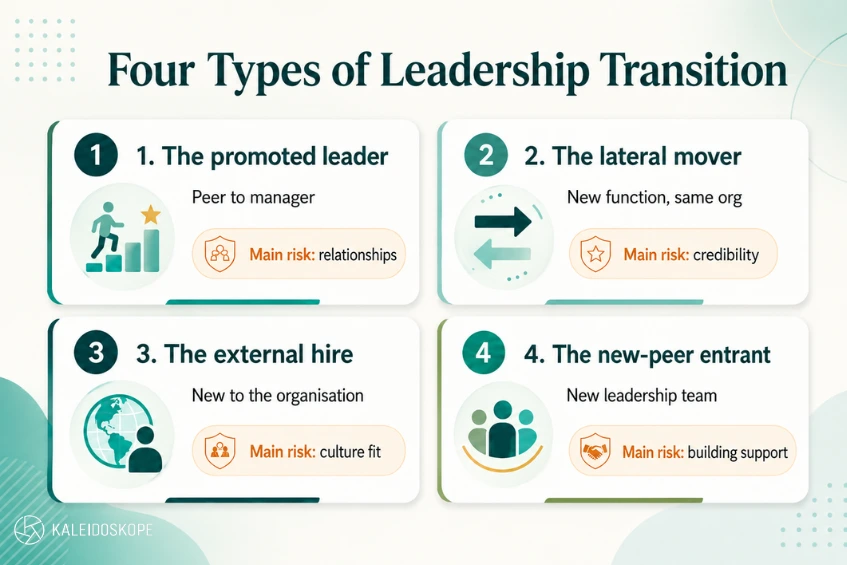
- There is no single type of transition. We work with four: the promoted leader, the lateral mover, the external hire, and the new-peer entrant. Each carries a different main risk.
- Internal promotions are harder than they look. The job itself is familiar, but leading former peers is not, and most companies support that relational shift poorly.
- In Singapore's tight talent market, where 83% of employers report difficulty finding skilled people, helping leaders succeed in new roles is now a competitive need.
The 40% Problem: Why Leadership Transitions Fail
Leadership transitions are among the highest-stakes moments in organisational life, and the odds are serious. The widely cited figure, first reported by executive search firm Heidrick & Struggles and echoed by the Center for Creative Leadership, is that around 40% of leaders fail, are removed, or leave within 18 months. McKinsey's own review of the major studies is more cautious but no less concerning: two years after a transition, between 27% and 46% of executives are regarded as failures or disappointments.
The causes are rarely about competence. The leader was, after all, chosen because they had a track record. What causes a leadership transition to fail is almost always the human and political work: misreading the culture, failing to align stakeholders, and leaving the role unclear. McKinsey found that 79% of external hires and 69% of internal hires say making culture change happen is difficult, and that only 32% of leaders feel their organisation supports new leaders well enough.
That support gap is the opportunity. The same research shows the upside is large: when a leadership transition succeeds, nine in ten teams go on to meet their three-year performance goals. Few other HR investments move the needle that far.
When a leadership transition succeeds, nine in ten teams go on to meet their three-year performance goals.
Leadership Transition: What the First 90 Days Are Really About
The "first 90 days" has become shorthand for instant impact, and that framing does new leaders a disservice. McKinsey's data is clear: 92% of external hires and 72% of internal hires take far more than 90 days to reach full productivity.
So what are the first 90 days of a leadership transition actually for? In our experience they are the window in which a leader sets their direction. This is the time for the diagnosis, the relationships, and the early signals that tell the organisation where things are heading. The work is to listen before setting the agenda, secure two or three credible early wins, and build the operating structure that makes later decisions predictable. The goal is direction, not completion.
Four Types of Leadership Transition
One of the most common mistakes we see is treating every leadership transition the same way. The diagnostic work and the relationship strategy differ sharply depending on how the leader arrived. We organise our work around four types.
The Promoted Leader (peer to manager)
The leader is promoted from within their own team. The technical work is familiar, but they must now lead people who were, until recently, peers. The main risk is relational, not operational: an unclear role, quiet resistance, and the discomfort of holding authority over friends.
The Lateral Mover (new function, same organisation)
The leader moves sideways into a different team, function, or business unit at a similar level. They keep their organisational knowledge but inherit an unfamiliar area and a team with its own history. The main risk is credibility: proving they belong in a discipline they have not run before.
The External Hire (new to the organisation)
The leader joins from outside. They bring a fresh perspective but lack the informal map of who holds influence and the cultural understanding that internal candidates take for granted. The main risk is cultural misalignment, which is exactly why external hires report the steepest culture-change difficulty in the data above. Helping them read and then lead through that change is where the early effort belongs.
The New-Peer Entrant (new leadership team)
The leader steps onto a leadership team as a newcomer among established peers, often after a reorganisation, merger, or fast period of growth. Their direct reports may be settled, but their relationships with these peers are brand new. The main risk is building support: earning trust with new peers before they need it.
Naming the type early lets us tailor the 90-day plan rather than apply a generic checklist. A promoted leader needs to reset relationships. An external hire needs to understand the culture. A new-peer entrant needs a plan for winning support. The framework below adapts to all four.
The Kaleidoskope 90-Day Capability Framework
Our leadership transition framework runs across three phases. It is built on the principle behind all our High-Performance Learning Journeys: capability is built through experience, not slides. This mirrors the well-known 70/20/10 model, in which roughly 70% of development comes from doing the job, 20% from learning through others, and 10% from formal training.
Phase 1: Diagnose (Days 1 to 30)
The urge to act fast is the first trap. We coach new leaders to hold back on visible change in month one and instead run a structured diagnosis:
- A listening tour across direct reports, peers, and key influencers.
- A stakeholder map sorted by power and interest, identifying sponsors, blockers, and connectors.
- A baseline of the metrics that matter, so later progress can be proven.
- An honest read of the culture and the informal influence network.
Phase 2: Stabilise and Win (Days 31 to 60)
With a diagnosis in hand, the leader shifts to action. The aim is two or three early wins that are visible, achievable, and aligned to what stakeholders already value. A good early win is meaningful, measurable, and shared. It shows priorities, proves capability, and builds the team at the same time. This is also when the leader sets out a clear 90-day plan to manage expectations.
Phase 3: Embed (Days 61 to 90)
The final phase turns momentum into structure so it lasts. We focus on the operating model: decision rights, review rhythm, team charter, and the capability-building that closes the gaps found in Phase 1. Without this, early wins quietly unravel. With it, the leadership transition becomes durable rather than dependent on individual effort.
The 90-Day Plan at a Glance
Here is the 90-day leadership transition plan in one view:
| Phase | Days | Focus |
|---|---|---|
| Diagnose | 1 to 30 | Listen, map stakeholders, set a baseline before acting |
| Stabilise and win | 31 to 60 | Secure two or three visible, valued early wins |
| Embed | 61 to 90 | Lock in decision rights, rhythm, and team capability |
The Hardest Case: Promotion from Within
Of the four types, the promoted leader is the one organisations most often under-support. The assumption is that someone who already knows the team and the work needs little help. The evidence says otherwise. Michael Watkins, who originated the first-90-days idea, found that 56% of people disagreed that their companies did a good job of supporting internal moves such as promotions.
The core task is redefining the role. The new leader must protect relationships they value while establishing the authority the role demands. We help them do three things on purpose rather than leave them to chance:
- Name the change. Hold honest conversations with former peers that acknowledge the shift, instead of pretending nothing has changed.
- Reset the operating norms. Redesign meetings, decision forums, and communication channels so the new structure is clear.
- Turn informal access into formal channels. A former-peer advisory group, for example, keeps their input while respecting the new decision boundary. Building these habits is the focus of our Leading and Managing Teams and Managing and Communicating Up programmes.
In Singapore and across much of Asia, where workplace relationships are often built on long-standing trust and a sensitivity to face, this reset needs particular care. Moving too bluntly can read as arrogance. Moving too softly leaves authority unclaimed. The key is staying close to the team while being clear about who now makes the decisions.
Measuring What Matters
The leaders we work with, especially those who must defend their decisions to a board, rightly want proof. We anchor measurement in a small set of areas rather than a long list of metrics: relationship strength, operational progress, team health, strategic impact, and the one most programmes ignore, learning transfer. Learning transfer is simply the degree to which new behaviour actually shows up in the workplace.
The discipline matters more than the tools. A weekly pulse, a 30-60-90 review with the sponsor, and agreed success criteria will catch problems far earlier than a quarterly report. The point is not to measure everything. It is to measure the few things that prove the leadership transition is on track, and to correct course while there is still time.
Why This Matters Now in Singapore and Asia
The regional context raises the stakes. ManpowerGroup's 2025 survey found 83% of employers in Singapore struggle to find the skilled talent they need, well above the 74% global figure. The World Economic Forum's Future of Jobs Report 2025 projects that 39% of core work skills will change by 2030. And Randstad's 2025 Workmonitor found three in four Singapore workers weigh training and development when choosing a job.
Put together, the message is clear. When talent is scarce and expensive to replace, helping the leaders you already have succeed in their new roles is one of the highest-return moves available. A failed leadership transition does not just cost one salary. It stalls a team, dents engagement, and sends a signal to the market. A well-supported one builds the resilient, adaptable leadership that Asia's fast-moving organisations are competing for.
Start Your Next Transition Right
Every leadership transition is a moment of risk, but it does not have to be a gamble. With a clear diagnosis, the right transition type identified, and a 90-day plan built around your context, you can turn high-stakes appointments into a repeatable source of advantage.
Kaleidoskope's leadership programmes are built for exactly this: helping HR and L&D teams prepare leaders to succeed in new roles. Several map directly to the challenges above, including Managing Stakeholders, Leading and Managing Teams, Leading through Change, Organisational Savvy, and Thriving Under Pressure. Every programme is customised to your organisation's specific challenges and delivered by facilitators with deep industry experience.
Talk to Kaleidoskope about supporting your leaders through their first 90 days
Frequently Asked Questions
- McKinsey & Company. "Successfully transitioning to new leadership roles."
- Watkins, M. "What McKinsey Gets Right and Wrong About Leadership Transitions." LinkedIn.
- ManpowerGroup Singapore. "83% of Employers in Singapore Struggle with Finding Skilled Talent in 2025."
- World Economic Forum, Future of Jobs Report 2025, via LSBF.
- Randstad Singapore. 2025 Workmonitor: 3 in 4 Need Development for Job Choices.
Disclaimer: This article is for general informational purposes only. Statistics and research findings cited are accurate as of June 2026 and are subject to change. Always verify current data with the original sources. The views expressed are those of Kaleidoskope and draw on our experience delivering leadership development programmes across Singapore and Asia. Last updated: June 2026.