

- Managing up is not flattery or office politics. It is a working relationship of mutual dependence, a term John Gabarro and John Kotter introduced in a 1980 Harvard Business Review article.
- Almost 60 percent of first-time managers receive no training at all, according to the Center for Creative Leadership, and Gartner found that 60 percent fail within 24 months, largely because of this lack of preparation.
- Every executive leans toward one of four working-style archetypes, the Sprinter, the Strategist, the Operator or the Architect, based on how fast they decide and how much detail they need first.
- A new manager can read their executive’s preferences in about 30 days through structured observation, testing and confirmation, rather than guessing or asking directly on day one.
- A workable communication routine has three parts: a short recurring update, a deeper monthly check-in, and a clear rule for what counts as urgent.
What Does Managing Up Mean?
Managing up means deliberately building a working relationship with your manager so both of you get what you need to do your jobs well, distinct from flattery or from taking over your boss’s job. Gabarro and Kotter’s framing rests on a simple fact. Bosses depend on their direct reports for cooperation, reliability and honesty. Managers depend on their bosses for organisational connections, priorities and resources. Neither side runs the relationship alone.
For a first-time manager, this looks like specific daily choices: knowing whether your director wants a one-line summary or the full backstory before a decision, understanding which problems need to reach them today versus the next scheduled update, and recognising that a senior leader juggling five direct reports and three board priorities does not have time to decode a vague status update.
This is different from the skill most new managers spend their first year building: managing downward through delegating, coaching and feedback. Managing up is a separate skill. Senior leaders notice it fastest, because it directly shapes how much confidence they place in a new manager’s judgement.
The First-Time Manager Training Problem
Most organisations do not train first-time managers at all, let alone on this specific skill. The Center for Creative Leadership has found that almost 60 percent of new managers receive no training when they step into their first leadership role. Gartner research, cited by Wharton Executive Education, found that 60 percent of new managers fail within their first 24 months, largely because of this lack of preparation.
Training budgets add to the problem. Leadership development budgets are typically weighted toward senior and mid-level leaders, leaving first-time managers to absorb the hardest transition in their career with the least support. A separate CareerBuilder survey of almost 4,000 managers found that 26 percent felt unprepared to lead when they started managing others, and 20 percent rated their own supervisor's performance as poor or very poor.
Managing up ends up as nobody’s job. It looks, on paper, like the senior leader’s responsibility to set clear expectations downward. In practice, senior leaders are stretched across multiple reports and rarely have time to explain their own working preferences in detail. The manager who figures this out early, without being told, earns trust with bigger problems sooner.
The Four Managing-Up Archetypes
Every executive processes information differently. Most first-time managers guess wrong for months before they notice a pattern. Two questions cut through the guesswork fastest: how quickly does this person want to decide, and how much detail do they need before deciding?
Plot those two questions against each other and four recognisable working styles emerge. This typology draws on two established ideas. Peter Drucker observed in Managing Oneself that some people absorb information best by reading and others by listening, and that guessing wrong on this point has derailed even experienced executives. Gabarro and Kotter made a similar point: understanding how a boss prefers to process information and make decisions is one of the most practical things a manager can learn about them.
The Sprinter. Wants the headline first, moves fast, and gets impatient with a long lead-in. A Sprinter interrupts a long explanation to ask, “So what’s the ask?” They decide once they have the core point, and value people who get to it quickly. Lead with the decision needed or the number behind it, then add detail only if asked.
The Strategist. Also wants the big picture, but takes longer to decide, because they map every request against the wider direction of the business. A Strategist asks, “How does this connect to what we said last quarter?” before committing. Frame updates around strategic context as well as the immediate task, and give them room to think before pressing for a decision.
The Operator. Decides fast, but only once the numbers are in front of them. An Operator trusts data over narrative and will push back on a recommendation that is not backed by evidence. Lead with the metric, the comparison, or the trend line, and keep the story short.
The Architect. Wants full documentation and reviews methodically before deciding. An Architect asks detailed follow-up questions and rarely approves anything on the spot. Send materials ahead of time, expect a longer decision cycle, and resist the urge to chase them for a faster answer.
Help Your New Managers Master Managing Up
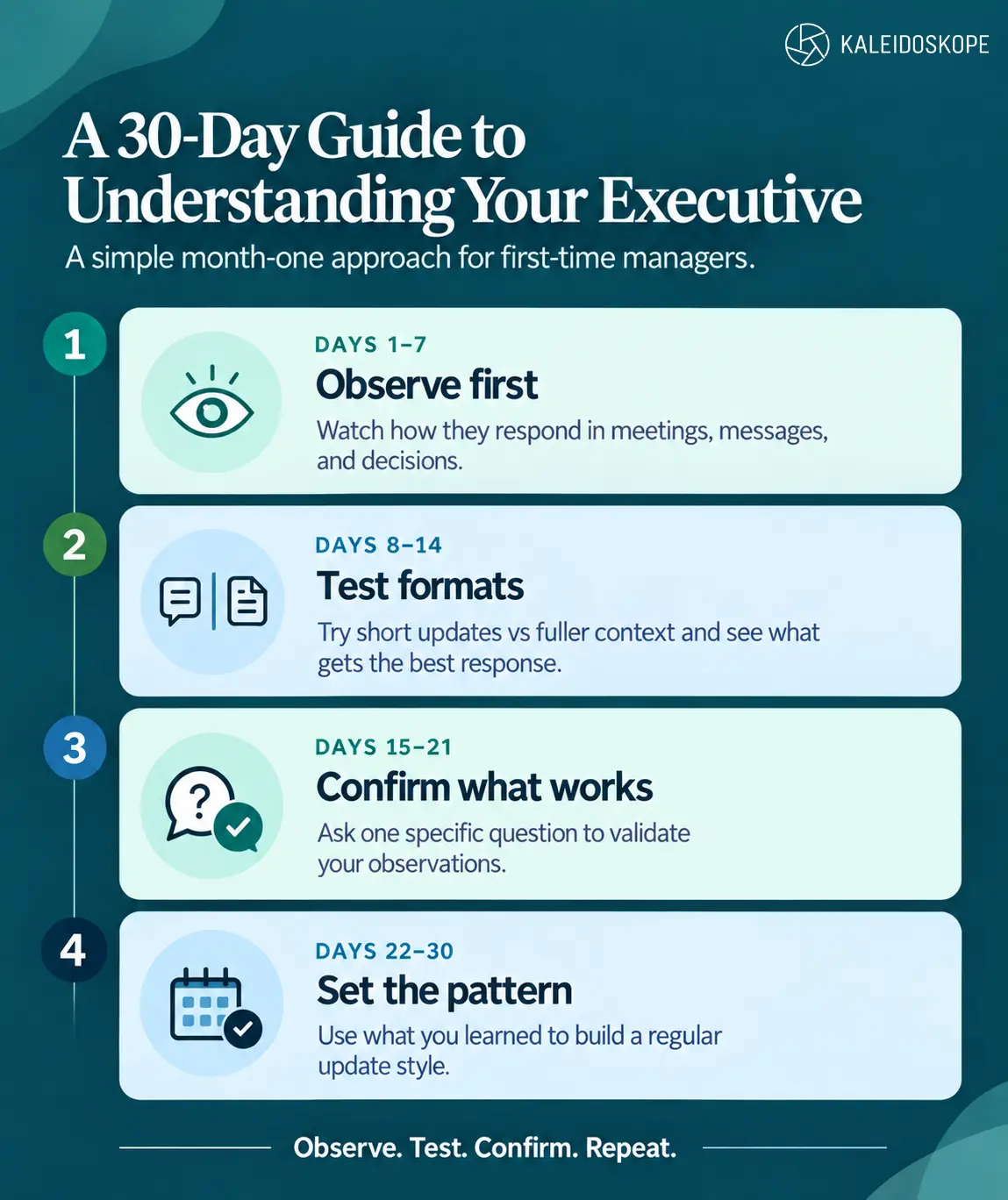
How Do You Read Your Executive’s Preferences in the First 30 Days?
Reading a new manager’s working style takes structured observation over several weeks. A single direct conversation will not settle it. Spreading the work across four weeks keeps it manageable alongside a full workload.
Building an Upward Communication Routine
A workable routine has three parts: a regular short update, a scheduled deeper check-in, and a clear rule for what counts as urgent.
The regular update should be brief and predictable, whether that is a weekly written summary or a short verbal check-in. It should cover what was decided, what is at risk, and what decision, if any, is needed from your manager. Keep it to the format your manager has already confirmed they respond to fastest.
The deeper check-in, typically monthly or aligned to a project cycle, is where strategy gets discussed. This is the space for the questions a Strategist or an Architect will want time to think through, separate from routine status updates.
Regular, predictable communication also has a track record that extends beyond the manager-to-report relationship. Gallup’s research on manager-employee communication found that people whose managers hold regular meetings with them are almost three times as likely to be engaged as those without, and the same logic applies in reverse. A first-time manager who is predictable and consistent upward earns the same kind of confidence a good manager earns from their own team.
Managing Up Develops With Practice
No one is going to hand a first-time manager a manual for managing up, because most organisations have not written one. The managers who figure it out early do so by paying close attention, testing what works, and building a communication routine their senior leaders can rely on. Like other management skills, this one improves with deliberate practice.
Kaleidoskope's Managing and Communicating Up workshop is built for exactly this problem. It equips new managers, mid-level managers and individual contributors to understand senior leaders' priorities and communication styles, practise stakeholder mapping and influence, and build the storytelling and conflict-resolution skills that make upward communication work. Enrol your team before this problem costs you a promotion cycle.
Ready to Equip Your Managers to Manage Up?
Kaleidoskope designs and delivers customised High-Performance Learning Journeys for organisations across Singapore and Asia, including the Managing and Communicating Up workshop for new managers, mid-level managers and individual contributors.
Frequently Asked Questions
- Gabarro, J. J. and Kotter, J. P. "Managing Your Boss." Harvard Business Review, first published 1980, reprinted January 2005. hbr.org/2005/01/managing-your-boss
- Center for Creative Leadership and Gartner research on first-time manager training and failure rates, as reported by Wharton Executive Education, "Managing to Fail? Why New Leaders Need Training," September 2024. executiveeducation.wharton.upenn.edu/thought-leadership/wharton-at-work/2024/09/new-leaders-need-training
- CareerBuilder survey of almost 4,000 managers, as reported in "Survey Finds One-Quarter of New Managers Feel Unprepared to Lead," Safety+Health Magazine. safetyandhealthmagazine.com/articles/survey-finds-one-quarter-of-new-managers-feel-unprepared-to-lead-2
- Drucker, P. F. "Managing Oneself." Harvard Business Review, Best of HBR 1999, reprinted January 2005. Excerpted at oreilly.com/library/view/hbrs-10-must/9781633692992/08_Managing_Oneself_es.html
- Gallup. "State of the American Manager: Analytics and Advice for Leaders," 2015, as reported in "The 3 Things That Employees Want From Their Managers," World Economic Forum. weforum.org/stories/leadership/the-3-things-that-employees-want-from-their-managers
Disclaimer: This article is for general informational purposes only. Statistics and research findings cited are accurate as of September 2026 and are subject to change. Always verify current data with the original sources. The views expressed are those of Kaleidoskope and draw on our experience delivering learning programmes across Singapore and Asia. Last updated: September 2026.