
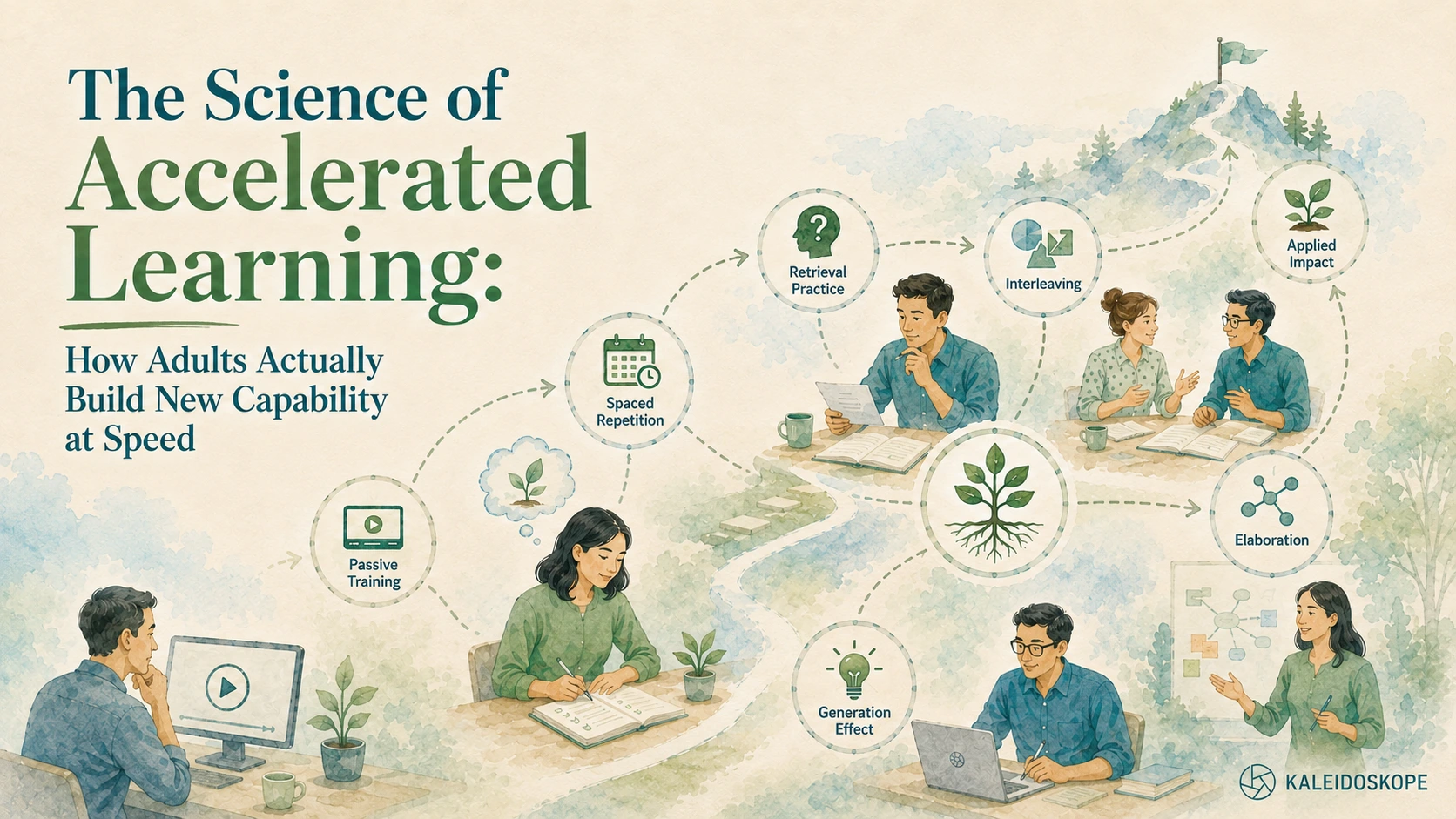
- Accelerated learning uses five cognitive science principles to build lasting workplace skills: spaced repetition, retrieval practice, interleaving, elaboration, and generation.
- Most corporate training violates all five by cramming content into single events, relying on passive slides, blocking topics into rigid modules, and giving pre-built answers.
- Each principle is anchored in peer-reviewed research by named scientists including Bjork, Roediger, Karpicke, Sweller, Dunlosky, and Slamecka, spanning decades of findings.
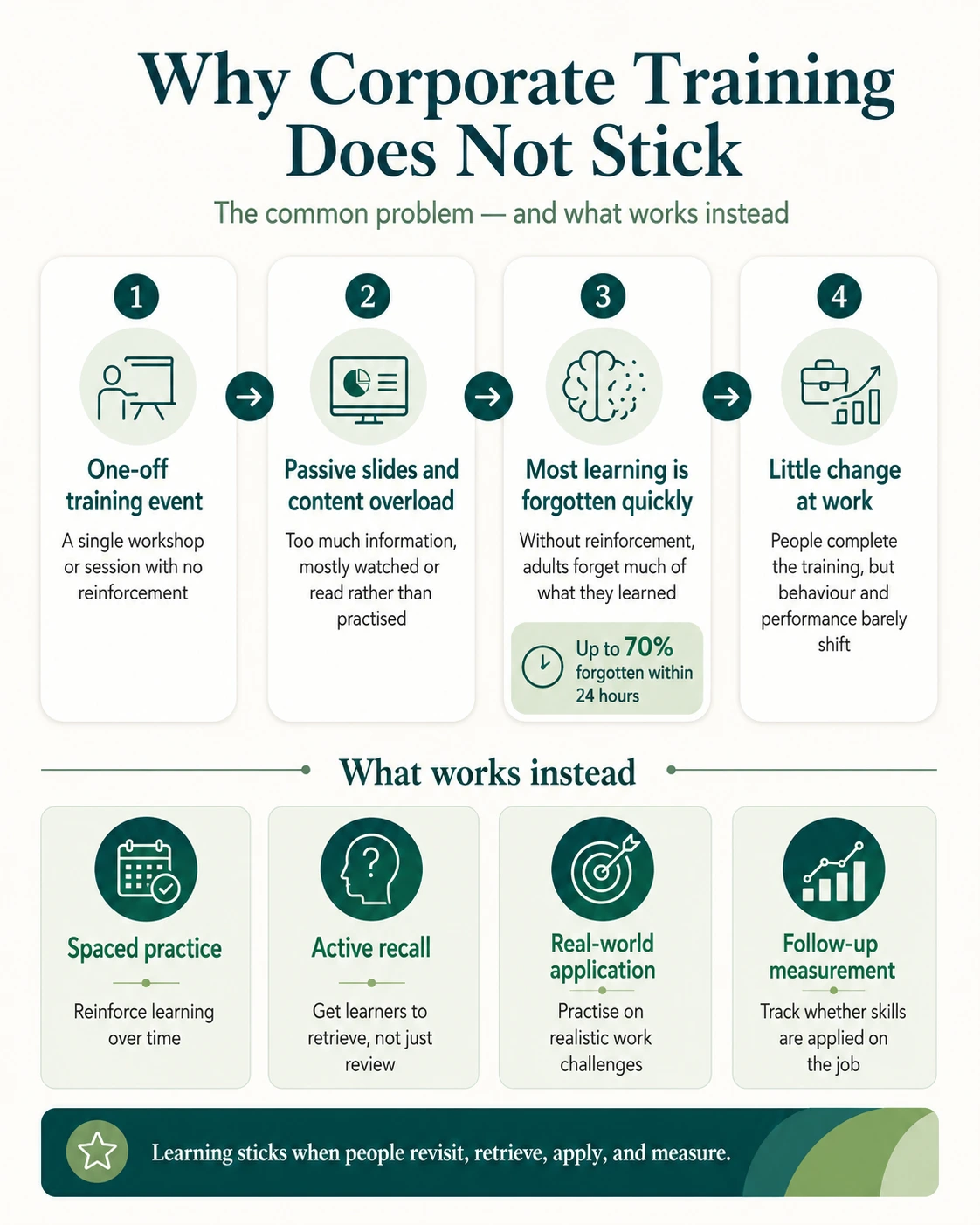
- The forgetting curve proves adults lose roughly 70% of new learning within 24 hours without reinforcement through spaced practice, active recall, and real-world application.
- When learning design works with how the brain actually encodes and retrieves complex skills, durable capability builds faster and transfers directly to workplace performance.
The Retention Problem Corporate Training Ignores
Without reinforcement, adults forget roughly 70% of what they have just learned within 24 hours. That finding comes from Hermann Ebbinghaus's forgetting curve, first published in 1885 and confirmed in a modern replication by Murre and Dros (2015). The global training market hit US$401 billion in 2024, yet most of that spending still follows the same pattern: put people in a room for a day, show them slides, and hope it sticks.
In Singapore, the stakes are real. More than 520,000 people took part in SkillsFuture-supported training in 2023. And in 2025, SkillsFuture Singapore changed its funding rules: courses now need to show real employment and performance results, not just completion numbers. The message is clear. It is no longer enough that people showed up. They need to be able to do something different afterward.
At Kaleidoskope, we design High-Performance Learning Journeys (HPLJ) for organisations across Singapore and Asia-Pacific. We have seen this gap up close. The answer is not more training. It is smarter learning design, built on five principles that science has proven over decades.
Five Principles That Make Learning Stick
1. Spaced Repetition
Spreading practice over time works far better than cramming everything into one sitting. Cepeda et al. (2006) confirmed this in a review of 254 studies with over 14,000 participants. Robert Bjork called this a "desirable difficulty" (Bjork, 1994): when your brain has to work harder to recall something after a gap, the memory gets stronger.
Where traditional training fails: Full-day workshops cram content into a single event because it is easier to schedule. Feedback forms look good right after the session, but 70% of that content is gone within a day.
2. Retrieval Practice
Pulling information out of memory works far better than reading it again. Roediger and Karpicke (2006) showed this clearly: people who tested themselves remembered much more than people who re-studied the same material, and the gap grew wider over days and weeks. They also found that most learners default to re-reading, which feels effective but creates what the researchers called the "illusion of competence."
Where traditional training fails: Reviewing slides, rewatching recordings, and re-reading handouts are all passive. They feel useful but never force the brain to actively recall, which is what makes learning last.
3. Interleaving
Mixing different but related skills during practice helps people figure out which approach fits which situation, just like in real work where problems do not come neatly sorted. Kornell and Bjork (2008) showed that mixed practice improved both learning and the ability to apply skills in new situations. Taylor and Rohrer (2010) found it produced 43% higher accuracy on later tests compared to practising one skill at a time.
Where traditional training fails: Most corporate courses teach one topic per module in strict order. Module 1 is Topic A, Module 2 is Topic B. It feels organised, but it never trains people to choose the right skill for the right moment.
4. Elaborative Interrogation
When learners explain why something is true in their own words, they connect new ideas to what they already know, and that connection is what makes the learning stick. Dunlosky et al. (2013), reviewing ten learning techniques in Psychological Science in the Public Interest, rated elaboration as effective across a wide range of topics and age groups. It works even better with experienced adults, because they have more existing knowledge to connect to. This is why the transition from technical expert to people leader is so difficult for first-time managers: the new skills feel disconnected from everything they built their career on, and elaboration is one of the fastest ways to bridge that gap.
Where traditional training fails: The trainer gives the explanation, and the learner listens. That skips the mental work of building the connections, which is the part that actually creates strong memory.
5. The Generation Effect
People remember things better when they come up with the answer themselves rather than being told. Slamecka and Graf (1978) were the first to prove this: participants who generated their own answers recalled about 15% more than those who simply read the answers. A later review of 86 studies by Bertsch et al. (2007) confirmed the finding. Hirshman and Bjork (1988) explained why: the mental effort of producing an answer is exactly what makes the memory stronger.
Where traditional training fails: Slides, videos, and lectures hand people the answers. Even when activities are included, learners usually apply a framework they were given rather than working out their own approach first.
Build Learning That Actually Sticks
Traditional Training vs. Accelerated Learning at a Glance
| Principle | What Most Corporate Training Does Instead |
|---|---|
| Spacing | Massed delivery: full-day workshops, no structured follow-up |
| Retrieval Practice | Passive review: re-reading slides, watching recordings |
| Interleaving | Blocked content: one topic per module in strict sequence |
| Elaboration | Pre-packaged explanations delivered by the facilitator |
| Generation | Provided answers: frameworks taught first, then applied |
The pattern is the same every time: traditional training is designed around convenience and comfort, which makes people feel good in the moment but does little for long-term skill building. Bjork's research explains the paradox: the easier learning feels, the less likely it is to last.
How We Apply These Principles: Kaleidoskope's HPLJ
At Kaleidoskope, every programme is designed as a customised High-Performance Learning Journey (HPLJ), not a one-off training event. Each HPLJ is built around three commitments: learning is experiential and grounded in real workplace challenges, every programme is tailored to the organisation's specific context, and outcomes are measured through observable performance change, not just satisfaction scores.
That approach aligns closely with the five principles in this article. Learning that is spaced across weeks rather than crammed into a single day. Practice that asks participants to apply, not just absorb. Facilitation by experienced practitioners who draw out participant thinking rather than deliver pre-packaged answers. And measurement that tracks what people actually do differently on the job, using tools including the Metrics That Matter (MTM) platform.
The result is learning that sticks because it is built around how adults actually form lasting skills, applied to real work from day one, and measured against business outcomes that matter to the organisation. These principles shape our full range of leadership development programmes, from first-time managers through to senior executives across Singapore and Asia-Pacific.
Frequently Asked Questions
Start With the Science
Accelerated learning is not a shortcut. It is a way of designing programmes that respects how the brain actually works, backed by decades of research from Bjork, Roediger, Karpicke, Sweller, Dunlosky, and Slamecka. The five principles are the conditions that make learning last. Training that ignores them will keep producing the same forgetting problem that has held back corporate L&D for years.
At Kaleidoskope, we build every High-Performance Learning Journey on these foundations. If you are ready to move from one-off training events to learning that actually sticks, we would welcome the conversation.
Let us design your next learning journey
Tell us what capability you are trying to build and we will design the journey around it.
- Bertsch, S., Pesta, B. J., Wiscott, R., & McDaniel, M. A. (2007). The generation effect: A meta-analytic review. Memory & Cognition, 35(2), 201-210.
- Bjork, R. A. (1994). Memory and metamemory considerations in the training of human beings. In J. Metcalfe & A. Shimamura (Eds.), Metacognition: Knowing about knowing (pp. 185-205). MIT Press. [Bjork Lab]
- Cepeda, N. J., Pashler, H., Vul, E., Wixted, J. T., & Rohrer, D. (2006). Distributed practice in verbal recall tasks. Psychological Bulletin, 132(3), 354-380. [PMC]
- Dunlosky, J., Rawson, K. A., Marsh, E. J., Nathan, M. J., & Willingham, D. T. (2013). Improving students' learning with effective learning techniques. Psychological Science in the Public Interest, 14(1), 4-58. [SAGE]
- Ebbinghaus, H. (1885/1913). Memory: A contribution to experimental psychology. Teachers College, Columbia University.
- Hirshman, E., & Bjork, R. A. (1988). The generation effect: Support for a two-factor theory. Journal of Experimental Psychology: Learning, Memory, and Cognition, 14(3), 484-494.
- Kornell, N., & Bjork, R. A. (2008). Learning concepts and categories: Is spacing the enemy of induction? Psychological Science, 19(6), 585-592.
- Murre, J. M. J., & Dros, J. (2015). Replication and analysis of Ebbinghaus' forgetting curve. PLOS ONE, 10(7), e0120644. [PLOS ONE]
- Roediger, H. L., & Karpicke, J. D. (2006). Test-enhanced learning: Taking memory tests improves long-term retention. Psychological Science, 17(3), 249-255. [SAGE]
- Slamecka, N. J., & Graf, P. (1978). The generation effect: Delineation of a phenomenon. Journal of Experimental Psychology: Human Learning and Memory, 4(6), 592-604. [ResearchGate]
- Sweller, J. (1988). Cognitive load during problem solving: Effects on learning. Cognitive Science, 12(2), 257-285. [Overview]
- Taylor, K., & Rohrer, D. (2010). The effects of interleaved practice. Applied Cognitive Psychology, 24(6), 837-848.
Disclaimer: This article is for general informational purposes only. Statistics and research findings cited are accurate as of September 2026 and are subject to change. Always verify current data with the original sources. The views expressed are those of Kaleidoskope and draw on our experience delivering learning programmes across Singapore and Asia. Last updated: September 2026.