
- The trap is the gap between being promoted for individual results and being measured on team results. The skills that earned the promotion are not the skills the role rewards.
- Around 60% of new managers underperform or fail within their first two years, usually from a lack of preparation rather than a lack of ability.
- Technical experts struggle because people-problems rarely have a single clear answer the way technical ones do, so their core strength stops being the job.
- Becoming a manager is a change in identity, not just a new set of tasks. The Center for Creative Leadership identifies six shifts it takes, from friend to boss and from doing the work to leading it.
- HR teams make the biggest difference when they prepare and support new managers before day one, not after they are already struggling.
Why So Many Technical Experts Fail at Their First Team
Managers are usually promoted because they were excellent at the job they are now leaving. Then the rules change overnight.
Research from CEB, now part of Gartner, found that around 60% of new managers underperform or fail within their first two years. The reason is rarely weak talent. It is that they were promoted for individual performance and never taught how to lead people.
The cost spreads across the team. When a new manager struggles, their direct reports perform around 15% worse on average and are roughly 20% more likely to disengage or leave. Gallup adds the reason it matters so much: managers account for at least 70% of the variance in team engagement.
Get the first management transition wrong and it does not just stall one career. It quietly lowers the performance of everyone on the team.
The fix is not more technical training. It is a different set of skills, learned deliberately.
Why the Skills That Earn the Promotion Stop Working
Technical experts struggle because the deep expertise that made them successful becomes a smaller part of the job, and can even work against them.
The transition is often described as a move from specialist to generalist. As a specialist, your value came from being the best at one craft: the strongest engineer, the sharpest analyst, the top closer. As a manager, your value comes from coordinating, coaching, and delivering results through other people. That work is broader, less visible, and harder to measure.
There is a deeper reason too. Technical problems usually have a right answer you can find and check. People-problems rarely do. A capable team member who has quietly stopped speaking up in meetings comes with no clear cause and no obvious fix. A tense relationship between two strong performers has no single correct solution. The instinct that always worked, to dig in and solve it yourself, does not help here, because there is nothing to fix in the usual sense.
This is the difference between technical and adaptive challenges: technical problems have known answers, while adaptive ones ask people to change how they think and work, which is most of what leading a team involves.
This is also why so many new managers report imposter feelings in their first months. They were confident and competent yesterday, and today they feel slow and exposed, spending their days on work they cannot point to. The Center for Creative Leadership puts the practical warning plainly: managers who keep relying on the technical expertise that earned them the promotion tend to be rated as less effective in their new role. The skill does not disappear. It simply stops being the job.
The 6 Identity Shifts Every New Manager Must Make
Before any of the day-to-day tactics, there is an underlying change in how a manager sees themselves. The Center for Creative Leadership, drawing on research by Bill Gentry, identifies six identity shifts that separate first-time managers who thrive from those who struggle.
Mindset.
Move from leading yourself to leading others. Success is now getting the best from each person, not delivering the best work personally.
Relationships.
Shift from peer and friend to boss. Former colleagues relate to you differently, and clear, fair expectations matter more than being liked.
Attitude.
Delegate the work instead of doing it all. Holding on to tasks starves your team of growth and makes you the bottleneck.
Perspective.
See the bigger picture, including organisational priorities and workplace politics, rather than treating them as distractions.
Focus.
Act on what is right, not what is easy or self-serving. Your decisions now carry beyond your own desk.
Skillset.
Build real people-leadership skills such as communication, influence, and feedback, rather than leaning on technical expertise.
Read together, the six describe one change: from being valued for what you produce to being valued for what your team produces. Every practical habit below is a way of living out one of these shifts.
How to Get the First 90 Days Right
The first 90 days, popularised by Michael Watkins as a make-or-break window, is where the trap either springs or gets disarmed. It is the same window that shapes any leadership transition, and four habits make the difference for a first-time manager.
Delegate instead of doing (2 to 3 tasks this week)
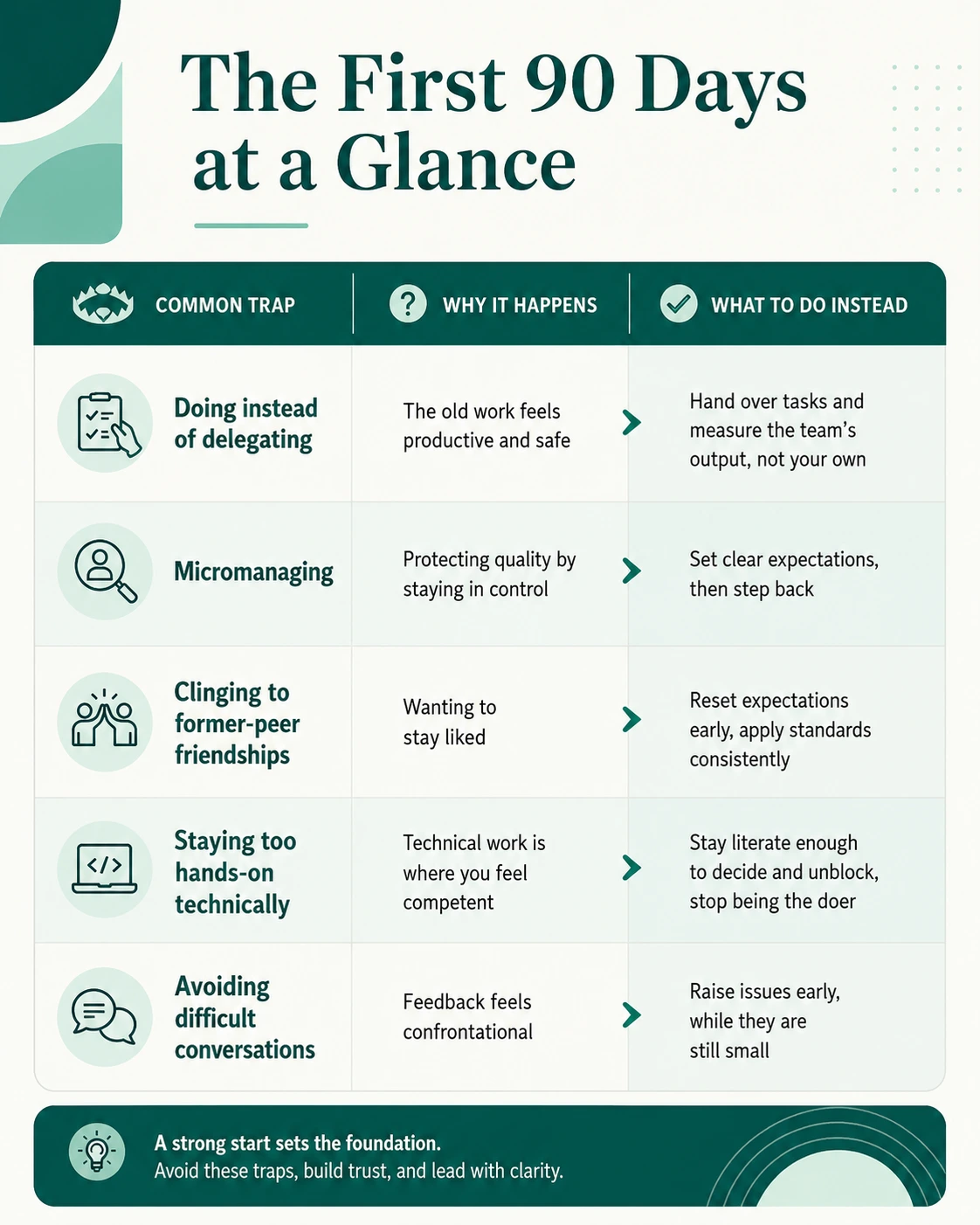
The strongest pull for a new manager is back toward the work they were good at, because it feels productive and safe. It is also the fastest way to become the bottleneck. Pick two or three tasks you would normally do yourself this week and hand them to the team, then judge yourself on their output rather than your own.
Reset relationships with former peers early
The relationship you had yesterday cannot survive unchanged, and both sides feel it. Trying to stay "one of the gang" only delays the reckoning and makes later decisions feel like betrayals. Have an honest conversation in the first week: be transparent about your new responsibilities, and apply standards consistently so no one suspects favouritism. In Singapore and across much of Asia, where trust and face carry particular weight, handle this reset with extra care. Move too bluntly and it reads as arrogance. Move too softly and authority stays unclaimed.
Stay technically literate, not hands-on
New technical managers get this balance wrong in both directions. Lean too far out and you lose the judgement to make good calls or clear real blockers. Lean too far in and you take the interesting work away from the people who should be growing into it. Accept that your team should become more skilled than you in specific areas. Your expertise is now a tool for asking sharper questions, not a licence to do the work yourself.
Have the difficult conversations while they are small
Avoiding feedback and unpopular decisions is one of the fastest ways a new manager loses credibility. A concern raised early, while it is still minor, is a two-minute conversation. Left to grow, it becomes a performance problem. Treat "I don't know" as normal, ask better questions, and address issues before they harden.
How HR Teams Make the Transition Stick
A first-time manager rarely succeeds on willpower alone. The organisations that get this right treat the promotion as the start of a new job, not the reward for the old one.
Check they want it before you promote.
Some of your strongest specialists do not want to manage people. Promoting them anyway loses a great engineer and gains a struggling manager. A technical career track with comparable pay and status keeps them growing without forcing the trap on them.
Prepare before day one.
Set clear role expectations and have an honest conversation about what the job actually involves.
Train for people skills, not process.
Prioritise delegation, feedback, coaching, and difficult conversations over policy and admin.
Pair each new manager with support.
A coach, a mentor, or a peer group of other new managers reduces the isolation that derails early transitions.
Reset how success is measured.
Assess new managers on team outcomes such as retention and development, not on the personal output from their old role.
One workshop rarely changes behaviour. Space the learning out, give managers something to apply between sessions, and check in across the first six months. Consistency is what turns a fragile promotion into durable leadership.
Start Supporting Your First-Time Managers
The first-time manager trap is predictable, which means it is preventable. Name the identity shift, protect the first 90 days, and build support in before day one.
Kaleidoskope's First-Time Manager programme is built for exactly this: turning promoted specialists into confident people leaders who lift team performance. Every programme is customised to your organisation's specific challenges and delivered by facilitators with deep industry experience.
Talk to Kaleidoskope about supporting your new managers
Frequently Asked Questions
- Center for Creative Leadership. How To Be an Effective Boss (Hint: It Requires an Identity Shift). Based on research by Bill Gentry, PhD.
- Arruda, W. Why Most New Managers Fail And How To Prevent It. Forbes, citing CEB (now Gartner) on the 60% failure rate and the 15% and 20% impact figures.
- Gallup. Managers Account for 70% of Variance in Employee Engagement. State of the American Manager.
- Watkins, M. The First 90 Days (Harvard Business Review Press), referenced for the 90-day transition window.
Disclaimer: This article is for general informational purposes only. Statistics and research findings cited are accurate as of July 2026 and are subject to change. Always verify current data with the original sources. The views expressed are those of Kaleidoskope and draw on our experience delivering leadership development programmes across Singapore and Asia. Last updated: July 2026.