
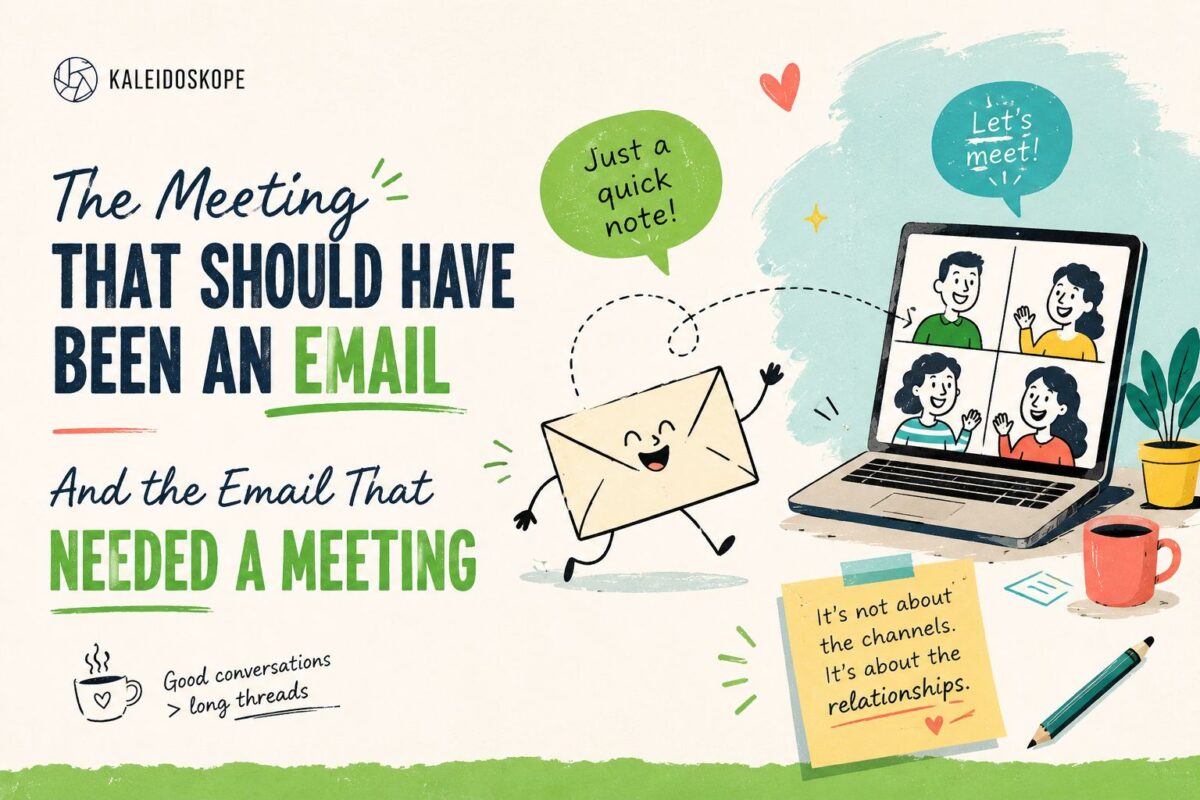
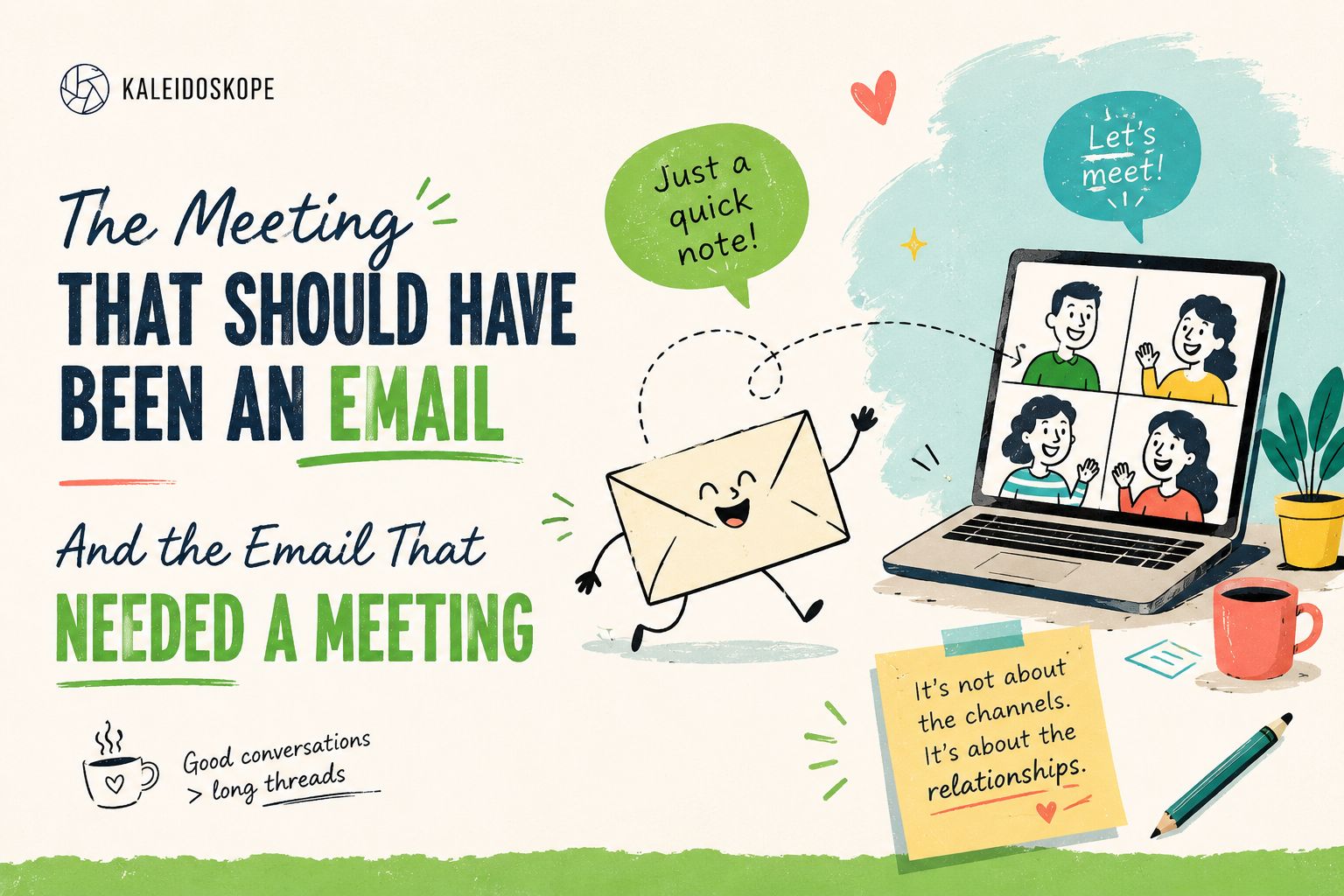
The Meeting That Should Have Been an Email
By Hwee Ching Ho
Director, Kaleidoskope Pte Ltd
Last week, I sat through a one-hour “alignment session” that could have been a four-line WhatsApp message. There were eight people on the call. Three of them had their cameras off (smart). One person was visibly eating. And by minute 40, I was questioning every life choice that had led me to that call.
We’ve all been there. You know you’ve been there.
And yet — the meetings keep getting scheduled.
Here’s what’s funny though. The same people who complain about too many meetings are often the ones sending the emails. You know the ones. The email that starts normally enough and then just… keeps going. Paragraph after paragraph. A question buried somewhere around paragraph nine. A “please advise” at the very end. And absolutely zero clarity on who is actually supposed to do something about it. And copied to half the organisation.
In many workplaces, email overload has become less about information-sharing and more about anxiety management — documenting, protecting, escalating, and making sure nobody gets blamed.
Both are exhausting. But here’s what I’ve come to realise: most workplace communication problems aren’t really about communication itself.
They’re about relationships.
Think about the best working relationship you’ve ever had.
A manager who just got you. A colleague you could fire off a three-word message to and they’d know exactly what you meant. A team where someone could say “I think we’re going in the wrong direction” in the middle of a meeting — and instead of awkward silence, you got a real conversation.
In those relationships, communication is almost effortless. Not because everyone’s a great communicator. But because the relationship does a lot of the heavy lifting.
It’s also a reminder of why communication is important in a team. The quality of communication is rarely just about clarity of language — it’s about psychological safety, trust, and whether people feel secure enough to be honest with each other.
And this is where it gets interesting — because most organisations try to fix communication by adding more of it. More channels. More check-ins. More town halls. More cascading updates. More. More. More.
But quantity was never the issue.
When leaders ask how to improve communication within a team, the instinct is often to add more structure or more tools. But communication rarely improves through volume alone.
What actually breaks down communication within teams isn’t the how — it’s the why underneath it. Why does this person always copy the boss on every email? Why does this team default to a meeting when a MS Teams message would do?
Usually, the answer comes back to the same few things:
People don’t feel safe enough to be direct. So they hedge. They over-explain. They loop in extra people as a form of self-protection. The email gets longer. The meeting gets scheduled.
Teams often fall into cycles of indirect communication when trust is low, while healthier cultures make space for respectful direct communication without fear or defensiveness.
People don’t know each other well enough to read the room. Tone gets lost. Intent gets misread. A perfectly reasonable message lands badly because there’s no relationship context to soften it. The thread spirals. The misunderstanding festers.
And in hybrid environments especially, reading the room has become harder than ever — which means small misunderstandings can quickly snowball into larger tensions.
People haven’t built enough trust to have the uncomfortable conversation. So instead of addressing the thing directly, they talk around it. In meetings that go nowhere. In emails that say a lot without saying anything at all.
None of this is anyone’s fault, really. We’re busy. Teams are increasingly hybrid or distributed. People join projects without ever properly meeting each other. And somewhere along the way, we forget that relationships are the infrastructure that output runs on.
When the infrastructure is shaky, everything gets harder. Decisions slow down. Miscommunications pile up. And everyone’s slightly more drained than they should be — not from the work itself, but from the friction of navigating it with people they don’t quite know how to read.
If organisations genuinely want to understand how to improve communication in the workplace, the answer may have less to do with communication tools — and more to do with relationship quality.
So what actually helps?
Not a communication framework. Not another team charter that lives in a shared drive nobody opens.
What helps is intentional investment in the relationship itself. Which sounds soft, but isn’t. It looks like:
- Actually learning how the people on your team like to communicate — and adapting, not just expecting them to adjust to you
- Creating enough psychological safety that someone can say “hey, that email came across a bit off — can we talk?” without it becoming a thing
- Spending a little time at the start of a project just… getting to know each other, before diving into the work
- As a leader, modelling the directness you want to see — being the first to say “this meeting could have been an email” and meaning it without blame
- Having a coffee instead of sending that email
Small investments. But they compound.
The best communication strategy you’ll ever have isn’t a strategy at all. It’s knowing your people. And letting them know you.
Try this next week — nothing dramatic, just small:
Before you send that long email, ask: is this actually about information, or am I just not sure this person will follow through?
Before you schedule that meeting, ask: do I actually need a decision, or do I just need to feel like we’re aligned?
And think about one person on your team you don’t know as well as you should. Grab a coffee. Ask them something real. It will do more for your communication than any workshop ever could.
(Though we do run pretty good workshops, just saying.)
At Kaleidoskope, this is the work we love most — helping teams get past the surface stuff and build the kind of relationships and trust that make everything else easier. If you’re curious what that could look like for your team, we’d love to have a conversation.
A real one. Short. Probably a call, not an email.
Related Blogs

Leadership Lessons from F1: Collaboration Under Pressure
What can Formula 1 teach leaders about collaboration under pressure? This article explores lessons in cross-functional teamwork, accountability, adaptability, and team dynamics from the 2026 race at Sepang.

Managing Up: A Guide for First-Time Managers
Managing up is a critical skill for first-time managers, yet it is rarely taught. Learn how to understand your manager’s priorities, adapt to different working styles, and build a clear communication routine that strengthens trust and confidence.
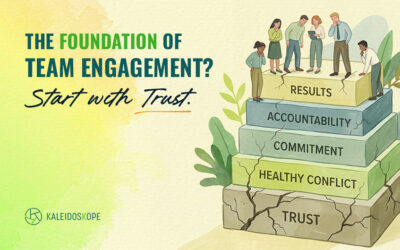
The Foundation of Team Engagement? Start with Trust.
Strong team engagement starts with trust. Explore how healthy conflict, commitment, accountability and shared goals create the foundation for stronger team performance.