
Why Group Chats Beat Managers at Feedback
By Hwee Ching Ho
Director, Kaleidoskope Pte Ltd
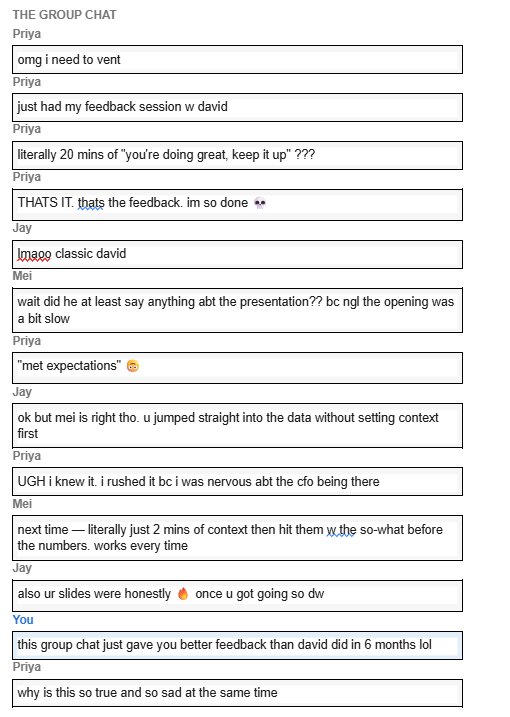
We’ve all been in that group chat.
The one that gets screenshots of emails, dissects meetings, and delivers in five minutes what six months of formal feedback never quite manages to say.
And here’s the uncomfortable truth: the group chat is often right. It’s faster, more specific, and delivered by people who were actually in the room. In many ways, it represents what effective feedback in the workplace is supposed to look like—but rarely does.
So why does it consistently outperform the formal feedback culture your organisation has spent so much time, effort, and budget trying to build?
The group chat isn’t smarter than your manager. It’s just safer. And that difference is the whole problem.
The answer has nothing to do with intelligence or effort. Your manager may be perfectly capable of nuanced, useful input. But the group chat wins because of three things formal feedback almost never has: psychological safety, specificity, and timeliness.
Priya’s friends aren’t thinking about performance ratings or HR implications. They’re not calibrating their words for a quarterly review. They’re simply offering constructive criticism grounded in what they observed—honest, direct, and delivered with care.
And that’s what makes it powerful.
Why the group chat wins every time
Here are three things the group chat gets right.
| Safe | No power dynamics. No career risk. People say what they actually think. |
| Specific | “Your opening was slow” beats “met expectations” every single time. |
| Timely | Delivered in the moment — not six weeks later in a structured review. |
When leaders don’t know how to speak honestly, feedback defaults to the vague and palatable.
“Keep it up.”
“Good effort.”
“Met expectations.”
Words that cost nothing to say—and do nothing to help.
The group chat bypasses all of that. Nobody is managing up, managing down, or managing optics. They’re managing the truth.
And it turns out, truth—delivered well—is what drives employee engagement, learning, and growth.
But let’s be fair to David for a moment
Before we dismiss every manager who has ever struggled with how to give a performance review, it’s worth acknowledging something:
Giving good feedback is genuinely difficult.
And the group chat, for all its honesty, has one enormous advantage that David doesn’t.
Context.
Priya’s friends know her. They understand her patterns, her strengths, her nerves. They know how she’ll receive feedback—and how much she can take at once.
David, on the other hand, is navigating that complexity across an entire team.
What makes feedback genuinely difficult
|
Cultural context Direct feedback lands very differently across cultures. What reads as refreshingly honest to one person lands as aggressive or face-threatening to another. A manager with a diverse team is navigating multiple norms simultaneously — often without a map. |
|
|
Communication preferences Some people want the blunt version. Others need context and warmth first. Some process feedback best in writing; others shut down if it isn’t delivered in conversation. Reading the room — every time, for every person — is a genuine skill that takes years to develop. |
|
|
Power dynamics Feedback from a manager carries weight that feedback from a friend simply doesn’t. The stakes are higher on both sides — which is precisely why so many managers retreat to the safety of “you’re doing great.” It feels kind. It avoids conflict. It just doesn’t help anyone grow. |
Add to this the reality that most managers were never actually taught how to give feedback. They were promoted because they were good at something — a craft, a skill, a set of results — and then handed a team and expected to figure out the human part themselves.
“Met expectations” isn’t laziness. Often, it’s anxiety in disguise.
Most managers don’t give bad feedback because they don’t care. They give it because nobody ever showed them what good looks like.
So what does good actually look like?
The goal isn’t to become your team’s best friend or to replicate the energy of a group chat in a performance review (please don’t). It’s to build the conditions — and the skills — where an honest feedback culture doesn’t require a private channel to exist.
Here’s how you can transition the conversation from group chat to a great feedback session.
| Know your audience | Invest time in understanding how each person on your team receives feedback best — culturally, personally, practically. |
| Name what you saw | Use SBI — Situation, Behaviour, Impact. Replace “met expectations” with what actually happened and why it mattered. |
| Give it now | Feedback decays fast. A quick word after the meeting beats a polished paragraph six weeks later. |
| Make it two-way | Ask for it as often as you give it. Leaders who receive feedback well signal that it’s safe to give it. |
The irony is that your team is already having the feedback conversation. They’re just not having it with you. Every “omg I need to vent” message is a small, funny, entirely human signal that the formal feedback channels aren’t doing their job.
Closing that gap isn’t simple. It requires cultural awareness, genuine curiosity about the people on your team, and the courage to say something real even when it’s uncomfortable.
That’s not a checklist — it’s a practice. And like most practices worth building, it takes time, intention, and usually a bit of help.
The question every leader should be asking
The question isn’t whether your people are getting feedback. It’s whether they’re getting it from you — or from someone else entirely.
Because when feedback lives outside formal systems, organisations don’t just lose control of performance conversations.
They lose opportunities for alignment, trust, and meaningful employee engagement.
At Kaleidoskope, we design learning journeys that help leaders build exactly this — the skills, cultural awareness, and confidence to make honest feedback a daily habit, not a once-a-year event. Get in touch to find out how we can help your team.
Related Blogs

Leadership Lessons from F1: Collaboration Under Pressure
What can Formula 1 teach leaders about collaboration under pressure? This article explores lessons in cross-functional teamwork, accountability, adaptability, and team dynamics from the 2026 race at Sepang.

Managing Up: A Guide for First-Time Managers
Managing up is a critical skill for first-time managers, yet it is rarely taught. Learn how to understand your manager’s priorities, adapt to different working styles, and build a clear communication routine that strengthens trust and confidence.
The Foundation of Team Engagement? Start with Trust.
Strong team engagement starts with trust. Explore how healthy conflict, commitment, accountability and shared goals create the foundation for stronger team performance.