
What Happens When Employees Stop Trusting the Message?
By Hwee Ching Ho
Director, Kaleidoskope Pte Ltd
A recent flight delay left me with a couple of unexpected hours at the airport. Normally, I would have headed straight for Sephora or spent the time browsing the duty-free shops, convincing myself that I needed something I probably didn’t.
Instead, I wandered into a bookshop and somehow found myself in the history section.
That was probably the last place I expected to find a leadership lesson.
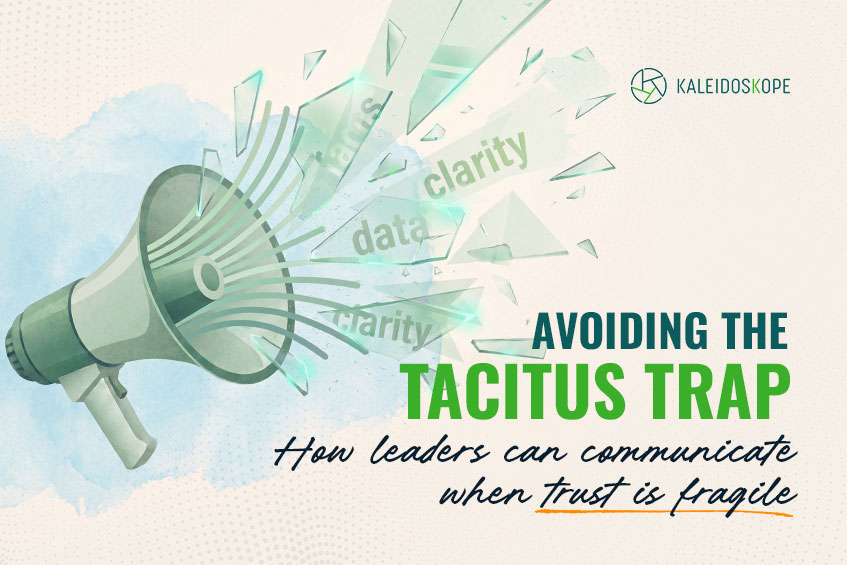
The Tacitus Trap
While browsing, I came across a reference to the Roman historian Tacitus and a concept that later became known as the Tacitus Trap.
The idea is simple: when people lose trust in those who lead them, even well-intentioned actions are viewed with suspicion. A good decision may be interpreted as self-serving. A reasonable explanation may be dismissed as spin. Even an attempt to correct a past mistake can be treated as evidence that something is being concealed.
Many of our clients come to us because they are trying to navigate change, transformation or growth. Often, the challenge is not a lack of effort on the part of leadership. Considerable thought has gone into the strategy. The rationale has been carefully articulated. Communication plans have been developed, town halls conducted and questions addressed.
Yet something still doesn’t quite land.
Employees remain sceptical. Rumours circulate. Informal conversations carry more weight than official messages. Leadership teams find themselves wondering why people seem unconvinced despite repeated attempts to explain the situation.
What if the issue isn’t that people don’t understand the message?
What If We Just Don’t Trust Our Leaders?
What if they don’t trust it?
That, I suspect, is where the Tacitus Trap becomes relevant.
One of the reasons I found the concept so compelling is that it challenges a common assumption in organisations: that facts are enough.
Most leaders I meet are intelligent, well-intentioned people. When faced with resistance or scepticism, their instinct is often to provide more information. The thinking is understandable. If people have the facts, surely they will see the logic.
The next presentation contains more data. The follow-up email offers further explanation. Another town hall is organised to address the questions that remain.
But organisations do not operate in a vacuum.
People do not receive information as neutral observers. They interpret it through the lens of their experiences, relationships and perceptions of leadership. The same message can be received very differently depending on the level of trust in leadership that already exists.
A leader announcing a restructuring, for example, may genuinely believe that the change will strengthen the organisation over time. Employees, however, may hear the announcement through the memory of an earlier transformation that was poorly handled. They may remember commitments that quietly disappeared, questions that went unanswered or decisions that seemed inconsistent with the organisation’s stated values.
In that context, the facts may be accurate, but accuracy alone will not make them persuasive.
Perhaps that is why leadership trust is so difficult to rebuild once it has been lost. Every new communication is judged not only on its content, but also against the backdrop of everything that came before it:
Promises made. Promises kept.
Decisions explained. Decisions avoided.
Questions welcomed. Concerns dismissed.
Over time, people form a view about whether leadership can be trusted. Once that view takes hold, it can become surprisingly resilient.
From Ancient Rome to Today’s Boardroom
As I thought about the Tacitus Trap, I found myself wondering whether some organisations spend too much time refining their messages and too little time strengthening the foundations that make those messages believable in the first place.
Clear communication will always matter.
But credibility matters just as much.
Because disagreement is not necessarily a problem. In healthy organisations, people can disagree, challenge one another and still move forward together. They may question a decision without assuming that those making it are dishonest or indifferent.
The greater risk is when people stop assuming good intent.
When every announcement is met with suspicion.
When official communication carries less weight than corridor conversations.
When employees find themselves asking at the pantry or watercooler, quietly or otherwise: “What’s the real story?”
That is when organisations may find themselves facing their own version of the Tacitus Trap.
This becomes especially important when leading through change. Change usually involves some degree of uncertainty. Leaders may not yet have every answer. Circumstances may evolve, and decisions may need to be adjusted as new information emerges.
In such situations, trust does not come from pretending to be certain. It comes from being honest about what is known, what remains unclear and how decisions will be made.
How to Communicate Clearly When Trust Is Fragile
When confidence in leadership is already strained, communicating more frequently may help—but only when the communication itself reflects credibility, consistency and respect.
A useful communication framework might begin with four questions.
1. What do we know?
Share the facts that can be communicated, in language people can understand. Avoid hiding a straightforward message behind corporate phrasing or unnecessary jargon.
2. What do we not yet know?
Acknowledge uncertainty rather than filling the gaps with false reassurance. People are often more capable of living with uncertainty than leaders assume. What they find harder to accept is the feeling that uncertainty is being concealed.
3. What principles are guiding the decision?
Explain not only what is happening, but how the organisation is thinking about it. What trade-offs are being considered? Whose interests may be affected? What values are shaping the response?
This allows people to evaluate the integrity of the process, even when they do not agree with every outcome.
4. What happens next?
Clarify when people can expect an update, where questions can be raised and how feedback will be considered. Then follow through.
This may sound simple, but knowing how to communicate clearly is not merely a matter of choosing the right words. It requires leaders to align their messages, behaviour and decisions over time.
No communication framework can compensate for a persistent gap between what leaders say and what people experience.
Before the Facts Stop Mattering
The Tacitus Trap may be an ancient idea, but the questions it raises feel remarkably current. They are certainly questions we find ourselves exploring regularly with leaders and organisations at Kaleidoskope.
How credible is leadership when the news is difficult?
Are leaders listening for what people genuinely think or merely repeating the message until resistance becomes quieter?
And does the lived experience of the organisation support what its leaders are saying?
Facts matter. Communication matters. A well-designed strategy matters.
But none of these exists independently of trust.
The challenge for leaders is not simply to make people believe a particular message. It is to create the conditions in which leadership communication can be believed in the first place. If you want to learn more about building trust in your organisation, let’s have a conversation.
Related Blogs

Leadership Lessons from F1: Collaboration Under Pressure
What can Formula 1 teach leaders about collaboration under pressure? This article explores lessons in cross-functional teamwork, accountability, adaptability, and team dynamics from the 2026 race at Sepang.

Managing Up: A Guide for First-Time Managers
Managing up is a critical skill for first-time managers, yet it is rarely taught. Learn how to understand your manager’s priorities, adapt to different working styles, and build a clear communication routine that strengthens trust and confidence.
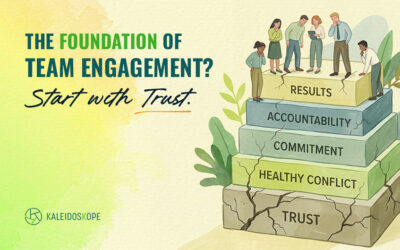
The Foundation of Team Engagement? Start with Trust.
Strong team engagement starts with trust. Explore how healthy conflict, commitment, accountability and shared goals create the foundation for stronger team performance.