
Finding Strength in Stress: Turning Pressure into Power
By Hwee Ching Ho
Director, Kaleidoskope Pte Ltd
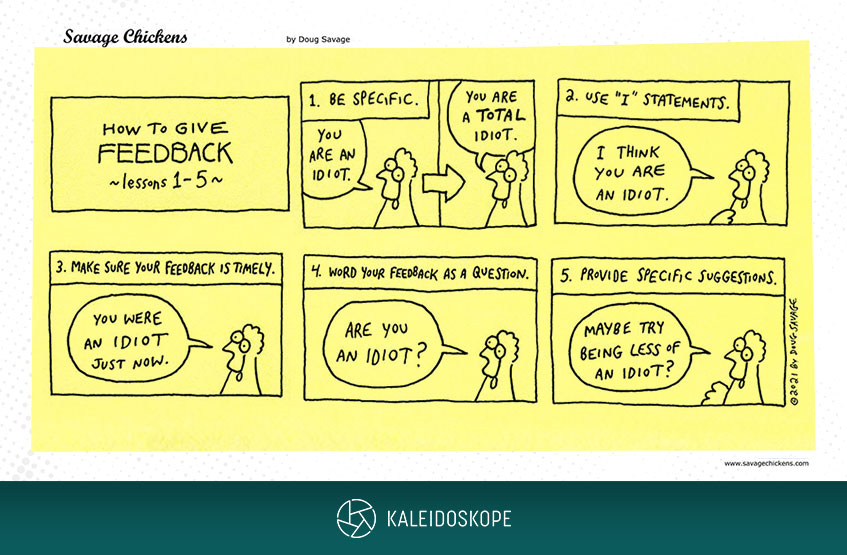
This cartoon makes us laugh because it highlights a very real tension: most people want to give feedback well — but aren’t always sure how.
Too often, feedback is treated as something reserved for managers, formal reviews, or that one conversation at the end of the year. When that happens, the feedback culture becomes heavy, awkward, and performative — a high-stakes moment rather than a meaningful exchange. What should be a powerful developmental tool is reduced to a tick-box exercise, disconnected from day-to-day work and real learning.
By the time annual feedback rolls around, the moment for impact has often passed. The missed opportunity, the unresolved tension, the unspoken frustration — all of it has already shaped behaviour, relationships, and performance.
At Kaleidoskope, we believe feedback works best when everyone is equipped to give it — intentionally, empathetically, and regularly — as part of everyday work for employee development.
Feedback is not an annual event. It’s a habit.
Why annual feedback conversations fall short
Annual feedback conversations carry an unrealistic burden. They are expected to:
- summarise a year’s worth of performance,
- address challenges that may have surfaced months earlier,
- motivate future growth,
- and preserve trust and morale — all in one sitting.
It’s no wonder they feel uncomfortable for both managers and employees. Effective feedback in the workplace becomes a challenge.
When feedback is infrequent, it becomes emotionally charged. People feel judged rather than supported. Managers soften messages to avoid demotivation. Employees brace themselves defensively. The conversation becomes more about evaluation than development.
As one employee once put it:
“We only talk about my goals once a year — by then, it’s too late to change anything.”
This isn’t a capability issue. It’s a design issue.
Reframing feedback as a shared responsibility
Feedback works differently when it’s not owned solely by managers.
When employees are empowered to give feedback to peers, collaborators, and leaders:
- conversations happen earlier, when they can still make a difference,
- issues are addressed with care, not accumulated frustration,
- trust builds through honesty, not silence.
Most importantly, feedback stops being about judging performance and starts being about helping one another succeed.
This shift from “managing performance” to developing people is subtle, but profound. It transforms feedback from something people endure into something they actively seek out and use.
What we learned from building a culture of meaningful conversations
Drawing from our work with a global organisation, we partnered closely with HR and leadership teams to reimagine how feedback was experienced across the employee lifecycle.
While formal performance processes were already in place, the quality and confidence of conversations varied widely. Feedback was happening, albeit inconsistently, cautiously, and often too late.
The aspiration was clear: to build a culture where conversations count, where feedback is frequent, human, and embedded into everyday work — not confined to an annual review cycle.
To support this shift, we designed a multi-month learning journey that equipped both managers and employees with the mindset, language, and practical tools to engage in feedback conversations that are clear, respectful, and growth-focused.
Not as a one-off intervention, but as a habit-building process to address development areas for employees.
The learning journey: practical and human
The learning journey was designed around a simple belief: feedback is a shared responsibility, not just a managerial task.
-
Foundations of Intentional Feedback
Participants explored what makes feedback genuinely useful — specific, balanced, and grounded in shared goals rather than judgment. Feedback was reframed as information for growth, not a verdict on worth or competence.
Simple, easy-to-apply frameworks helped normalise feedback as an everyday practice rather than a once-a-year event.
-
Empathy & Courage in Feedback Conversations
Giving feedback isn’t just about clarity, it’s also about emotional intelligence.
Participants learned how to:
- express impact without blame,
- manage their own emotional responses,
- listen with curiosity rather than defensiveness.
By understanding why feedback conversations can feel threatening, people become better equipped to stay present, respectful, and constructive, even when conversations are difficult.
-
Making Feedback Frequent and Consistent
The final emphasis was on rhythm and habit.
Feedback was positioned as something that informs development throughout the year — in one-on-ones, project check-ins, and informal conversations — rather than something saved up for formal reviews.
When feedback becomes frequent, it also becomes lighter. There’s less pressure, less drama, and far more learning.
A healthier way to build performance
When employees know how to give feedback well, conversations happen naturally — earlier, more honestly, and with far less friction.
Performance improves not because people are more tightly managed, but because they feel:
- supported rather than scrutinised,
- seen rather than assessed,
- trusted rather than controlled.
Feedback becomes a signal of care, not criticism.
And over time, this creates something far more powerful than a well-run performance cycle: a culture of trust, alignment, and continuous growth.
Moving forward, one conversation at a time
If you’re looking to move beyond tick-box feedback and build a culture where conversations genuinely count, we’d love to explore how this kind of learning journey can be tailored for your organisation.
Because feedback isn’t about pointing things out once a year —it’s about moving forward together, one conversation at a time.
Related Blogs
Leadership Lessons from F1: Collaboration Under Pressure
What can Formula 1 teach leaders about collaboration under pressure? This article explores lessons in cross-functional teamwork, accountability, adaptability, and team dynamics from the 2026 race at Sepang.

Managing Up: A Guide for First-Time Managers
Managing up is a critical skill for first-time managers, yet it is rarely taught. Learn how to understand your manager’s priorities, adapt to different working styles, and build a clear communication routine that strengthens trust and confidence.
The Foundation of Team Engagement? Start with Trust.
Strong team engagement starts with trust. Explore how healthy conflict, commitment, accountability and shared goals create the foundation for stronger team performance.