
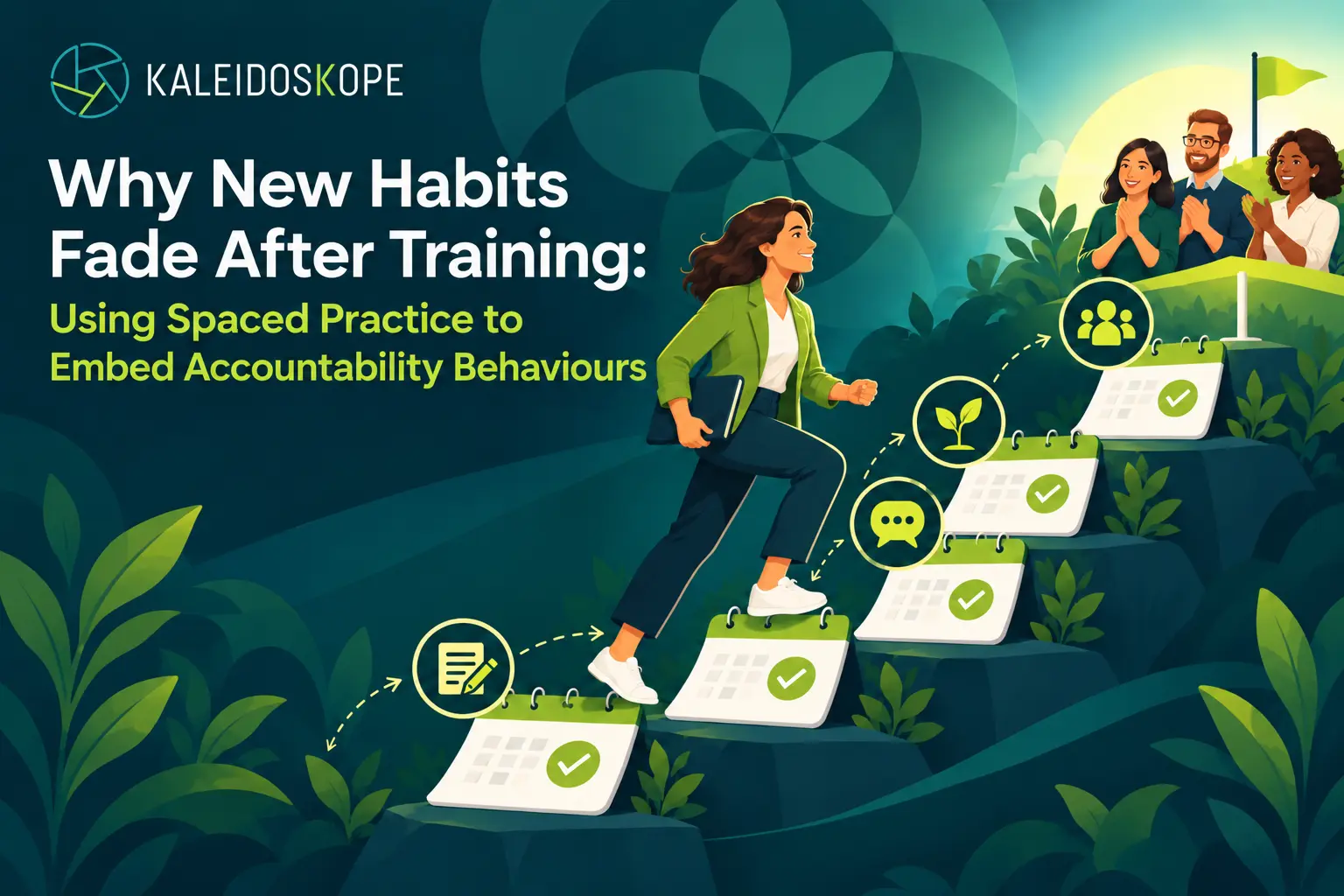
- Lally et al. (2010) found new daily habits took a median of 66 days to feel automatic, ranging from 18 to 254 days. A two-day workshop covers only about 3% of that 66-day period.
- Accountability behaviours such as clear commitments, early warnings, and honest follow-up involve social risk, so they fade fastest when nobody back at work expects to see them.
- Four mechanisms help new habits last beyond the workshop: spaced practice, peer accountability, manager sponsorship, and environmental cues, each one backed by peer-reviewed research.
- A meta-analysis of 89 studies (Blume et al., 2010) found that the work environment matters more for open skills like leadership than for closed skills like using new software.
- Kaleidoskope’s methodology says learners need agreed objectives, coaching, manager support and peer review, and it uses Metrics That Matter analytics to check its programmes work.
The Monday After the Workshop
Your managers spend two days at a leadership workshop. They practise setting clear expectations, raising a flag when a deadline is at risk, and following up on commitments without making it personal. The feedback forms are full of praise.
On Monday, 200 unread emails are waiting. A deadline slips and nobody says a word until it's too late to fix. By week three, the action plan written on Friday afternoon is forgotten.
The content may well have been excellent. The problem is simpler, and easier to fix. New behaviour needs far more repetition than any workshop can give. It also needs that repetition where the old habit lives, which is Monday's meeting.
If you have run leadership programmes before and watched the results fade, this article is for you. It covers how habits form, why short workshops struggle, and four mechanisms that help new accountability behaviours stick. We also show how our leadership training programmes apply them.
Sound familiar? If your last programme faded by week three, let's talk about building the reinforcement in from day one.
What the Research Says About How Long Habits Take
Phillippa Lally and her colleagues at University College London (2010) studied how long habits take to form. They asked 96 volunteers to pick one new daily behaviour, such as eating fruit with lunch or going for a run before dinner. Volunteers repeated it in the same context every day for 12 weeks and rated each day how automatic it felt.
The median time to reach peak automaticity was 66 days. The spread was wide, from 18 days for the fastest participant to a projected 254 days for the slowest. Three findings matter for anyone designing training:
Early repetitions matter most.
Automaticity grew fastest in the early days. That's good news for leaders who need visible progress in the first few weeks.
One missed day does little harm.
Missing one opportunity made little difference to habit formation.
Context is the trigger.
Participants tied their behaviour to a consistent cue, such as "after breakfast".
The 66-day figure has limits. It is a median from simple health behaviours, and it covers only the participants whose data fitted the researchers' model well. Workplace behaviours like holding a peer to account are more complex, so they may take longer. The timeline runs in weeks and months.
What Are Accountability Behaviours?
Accountability behaviours are the visible, everyday actions that show people own their commitments. They include:
Making clear commitments: who will do what, by when
Flagging early when something is at risk, without waiting to see if it resolves itself
Owning a miss without blame or excuses
Following up on other people's commitments, respectfully and consistently
Closing the loop when the work is done
These are behaviours you can see and coach, so you can also build them into habits. As we explored in our recent piece on what Formula 1 teaches about collaboration under pressure, accountability breaks down quickly when ownership and roles are unclear. Training teaches the skills. Repetition at work makes them automatic.
Why Two-Day Workshops Struggle to Change Manager Behaviour
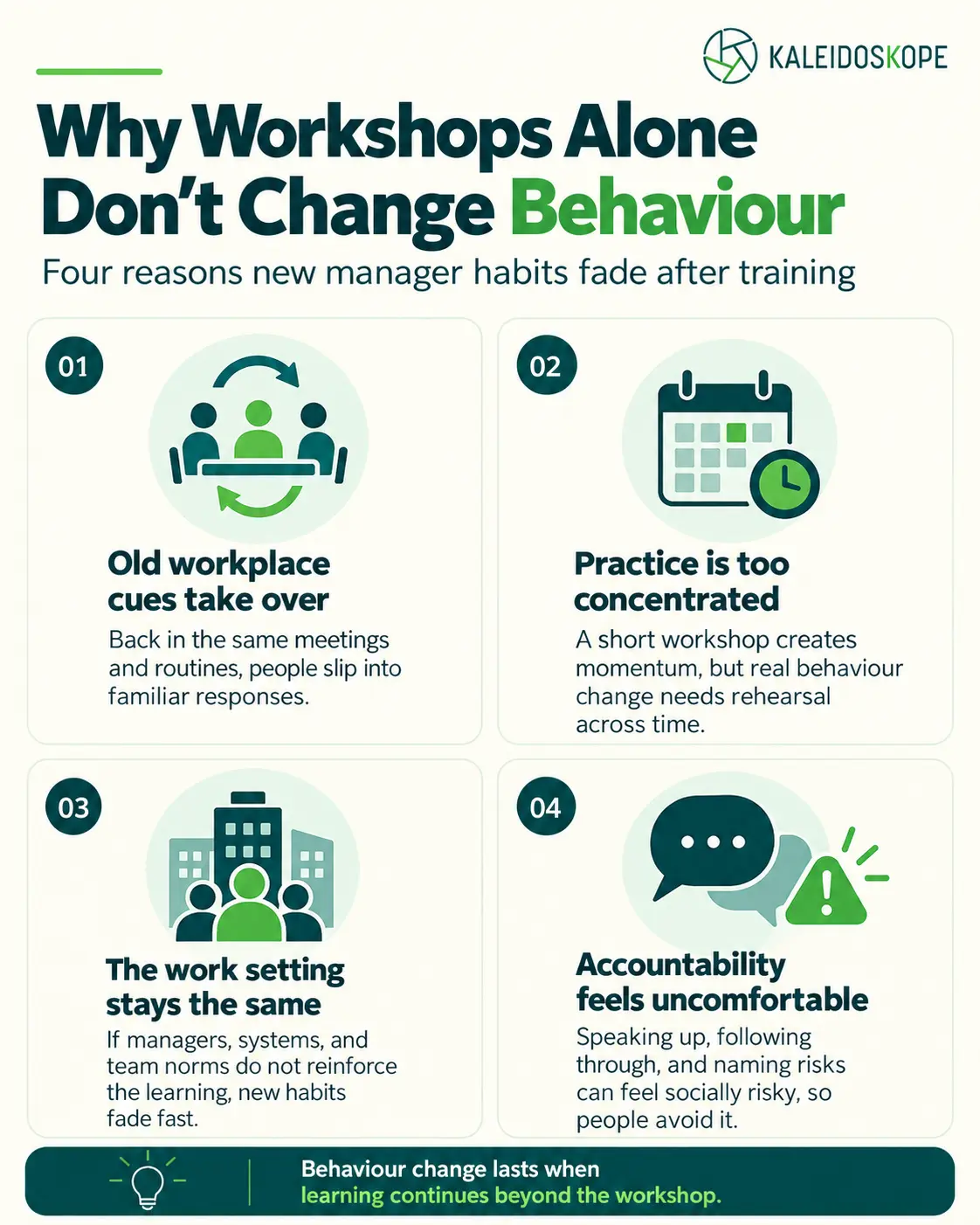
If a new habit takes around 66 days to form, a two-day workshop covers about 3% of that time. Even a well-designed workshop cannot do the other 97% on its own. Four things usually get in the way.
1. The practice happens in the wrong place
Wood and Neal (2007) showed that habits are triggered by cues in the setting where they were learned, such as the place, the people and the time of day. Back at work, the cues are the old ones, such as the same meeting and the same colleagues. Those cues trigger the old response.
2. All the practice is crammed together
Spacing practice over time works better than cramming (we cover it in detail in the science of accelerated learning). In a study of more than 1,350 people, Cepeda et al. (2008) found that the best time between practice sessions grows with how long you need to remember something. If you want a skill to last a year, spread practice sessions across weeks.
3. The workplace has not changed
A meta-analysis of 89 studies by Blume et al. (2010) found higher transfer where the work environment is supportive. Most of these links are stronger for open skills such as leadership than for closed skills such as learning new software.
4. Accountability behaviours involve social risk
Telling a colleague their piece of work is late, or admitting that yours is, can feel uncomfortable. Where seniority and saving face matter, as they often do across Asia, the pull to stay silent is strong. A behaviour that feels risky is the first one people drop when nobody is watching. That is why it needs deliberate reinforcement.
The Four Reinforcement Mechanisms That Make New Habits Stick
These four mechanisms keep new habits going after the workshop. Each one is backed by peer-reviewed research, and each works best alongside the others.
1. Spaced Practice
Spaced practice means returning to a skill in shorter sessions spread over weeks, with real work in between. Spacing strengthens memory (Cepeda et al., 2008). Habit science adds a second point: each return should push people to use the skill in a real situation, so the new behaviour links to workplace cues. In practice, that means shorter sessions over two to three months, with check-ins at weeks one, two, four and eight.
2. Peer Accountability
A meta-analysis of 138 studies by Harkin et al. (2016) found that monitoring progress improved goal attainment. The effects were larger when progress was reported to others or made public, and when it was written down. In learning pairs or trios, partners swap short updates on one commitment each and talk honestly about what got in the way. It works best when people feel safe to admit a slip. That is one reason we encourage organisations to build a regular feedback culture and give feedback throughout the year.
3. Manager Sponsorship
Of all the work environment factors, the participant's own manager has the most daily influence. Transfer research links supportive work environments, including supervisor support, to higher use of training on the job (Blume et al., 2010). A manager who asks about the new behaviour shows that it matters. A manager who never mentions it shows that it does not. Sponsorship starts before the programme, with a short conversation to agree what should change, and the 15-minute coaching method we shared earlier this year works well here.
4. Environmental Cues
Because habits are triggered by context (Wood & Neal, 2007), a practical way to help a new behaviour stick is to design the cue into the working day. One proven tool is the implementation intention, a simple if-then plan. In a meta-analysis of 94 tests, Gollwitzer and Sheeran (2006) found that if-then planning had a medium-to-large effect on goal attainment (d = 0.65). An if-then plan for accountability might read: "If a deadline I own is at risk, then I will tell the person relying on it the same day." Pair plans like this with visible cues, such as a standing agenda item or a calendar reminder before the weekly review.
See how Kaleidoskope designs programmes that change behaviour, not just knowledge
How Kaleidoskope Builds Reinforcement Into Every Learning Journey
At Kaleidoskope, we've never treated the workshop as the finish line. Our methodology starts from a simple belief that learning continues after the event.
Our High-Performance Learning Journey (HPLJ) is based on the approach pioneered by Dr Robert O. Brinkerhoff, the learning effectiveness expert behind the Success Case Method. Kaleidoskope is the only learning programme provider in Singapore certified in Dr Brinkerhoff's Learning Journey Approach, which balances four elements:
Committing to the Journey:
the return on learning is defined for both participants and the organisation.
Building the Knowledge Foundation:
participants gain enough knowledge before the main learning event to start practising.
Developing and Practising Skills:
practice builds both the skill and the confidence to use it as a better way of getting work done.
Strengthening Results:
participants leave with the tools and direction they need to keep applying what they learned.
Those elements match the four mechanisms in this article. Our methodology calls for clearly agreed objectives before training, which is where manager sponsorship begins. It also calls for coaching, real chances to use new skills in the day-to-day role, and support from the participant’s immediate manager back at work. It also calls for opportunities to review progress with peers and the facilitator, which is where peer accountability happens. A learning journey platform from our partner Promote International helps keep these conditions in place between sessions.
We also measure results. With our learning analytics partner, Metrics That Matter (MTM), we work with clients to show whether people enjoyed the session and whether learning turns into results. Our experienced facilitators bring these principles into every one of our leadership development programmes, from first-time managers to senior executives across Singapore and Asia-Pacific.
Frequently Asked Questions
From Knowing to Doing
Most training fails because nothing helps people keep practising once they are back at work. Habit research shows new behaviours take weeks and months to become automatic.
For HR and L&D leaders across Singapore and Asia, the question to ask of any programme is what will help people do this on day 30, day 60 and day 90.
At Kaleidoskope, we ask that question in every High-Performance Learning Journey we design. If you want your next programme to change behaviour, we would welcome the conversation.
Let's design your next programme
Tell us which behaviours you want to see more of, and we will design the programme around them.
- Blume, B. D., Ford, J. K., Baldwin, T. T., & Huang, J. L. (2010). Transfer of training: A meta-analytic review. Journal of Management, 36(4), 1065-1105. [DOI]
- Cepeda, N. J., Vul, E., Rohrer, D., Wixted, J. T., & Pashler, H. (2008). Spacing effects in learning: A temporal ridgeline of optimal retention. Psychological Science, 19(11), 1095-1102. [PubMed]
- Gollwitzer, P. M., & Sheeran, P. (2006). Implementation intentions and goal achievement: A meta-analysis of effects and processes. Advances in Experimental Social Psychology, 38, 69-119. [KOPS]
- Harkin, B., Webb, T. L., Chang, B. P. I., Prestwich, A., Conner, M., Kellar, I., Benn, Y., & Sheeran, P. (2016). Does monitoring goal progress promote goal attainment? A meta-analysis of the experimental evidence. Psychological Bulletin, 142(2), 198-229. [White Rose]
- Lally, P., van Jaarsveld, C. H. M., Potts, H. W. W., & Wardle, J. (2010). How are habits formed: Modelling habit formation in the real world. European Journal of Social Psychology, 40(6), 998-1009. [DOI]
- Wood, W., & Neal, D. T. (2007). A new look at habits and the habit-goal interface. Psychological Review, 114(4), 843-863. [PDF]
Disclaimer: This article is for general informational purposes only. Research findings cited are accurate as of October 2026 and may change as new studies are published. Always check current data with the original sources. The views expressed are those of Kaleidoskope and draw on our experience delivering learning programmes across Singapore and Asia. Last updated: October 2026.