Kaleidoskope - How to Build High Performing Teams

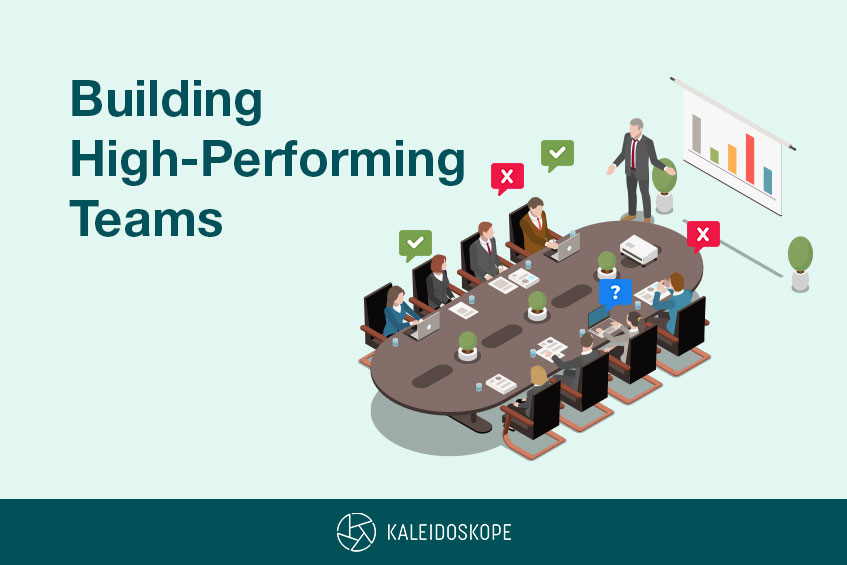
Building High-Performing TeamsBuilding High-Performing Teams In any organisation, the team is the fundamental unit of work. It’s  where the rubber meets the road — where strategy gets executed and results are achieved. For this reason, team performance is essential to organisational success.

Building High-Performing Teams

In any organisation, the team is the fundamental unit of work. It’s  where the rubber meets the road — where strategy gets executed and results are achieved. For this reason, team performance is essential to organisational success.

There are a number of factors that contribute to team performance, and effective team management is among the most crucial. Managing a team is never easy, but by understanding the dynamics of team performance, leaders can put in place the systems and processes needed to build and sustain formidable teams.

Successful team management spells the difference between average and great results. Great teams are cohesive, focused, and effective. They are also able to overcome obstacles and accomplish their goals. On the other hand, dysfunctional teams are often bogged down by conflict, low morale, and ineffective communication. So how can team managers ensure that their team is functioning at its best?

In our new blog, Paul Stuart, Kaleidoskope Co-founder, Master Facilitator and Senior Director of Client Solutions, gives an insightful discussion on effective, efficient, and exceptional team leadership.


Dysfunction # 1: The absence of “Vulnerability-based” trust

“Great teams do not hold back with one another. They are unafraid to air their dirty laundry. They admit their mistakes, their weaknesses, and their concerns without fear of reprisal.” 

– Patrick Lencioni

This quotation from Patrick Lencioni, the author of the “5 Dysfunctions of a Team,” provides a key insight into the first of the 5 Dysfunctions: Absence of trust.

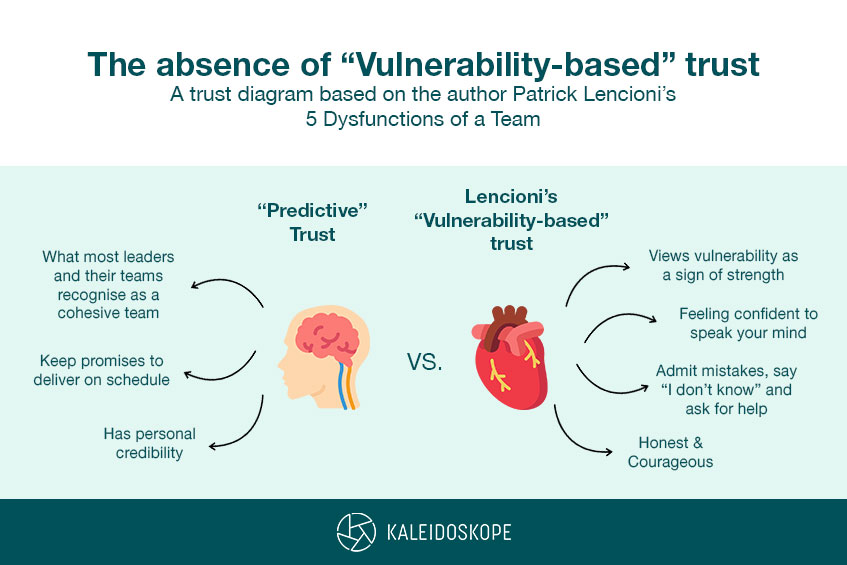
Whilst most leaders and their teams recognise the importance of trust in building a cohesive team, the type of trust which they normally refer to is what is known as “predictive” trust. 

Although this type of trust is of course important, it’s not the type of trust that the 5 Dysfunctions model is based on. Instead, Lencioni terms this type of trust as “vulnerability-based” trust.

So what’s the difference between “Predictive” trust and Lencioni’s “Vulnerability-based” trust?

Kaleidoskope - Patrick Lencioni's Trust Diagram - Dysfunctions of a Team

If “Vulnerability-based” trust is absent in a team, then their chances of reaching a high level of performance are significantly reduced. But, if a team can create this kind of atmosphere and culture, then they will have overcome the first of the 5 Dysfunctions — and the key to achieving this is courage. To encourage this behaviour in others, it first has to be exhibited by the leader.

Dysfunction # 2: The fear of conflict

“Contrary to popular wisdom and behaviour, conflict is not a bad thing for a team.  In fact, the fear of conflict is almost always a sign of problems.”

 – Patrick Lencioni

So, which problem is Lencioni referring to?

“Contrary to popular wisdom and behaviour, conflict is not a bad thing for a team. In fact, the fear of conflict is almost always a sign of problems,” according to Lencioni.

The key problem is fairly straightforward. Unless there is some “conflict” or at least disagreement within a team, it’s unlikely that they are able to engage in the unfiltered and passionate debate that is necessary for all ideas and suggestions to be thoroughly reviewed and ensure that they add value to the business. Instead, teams resort to veiled discussions and guarded comments resulting in less than optimum decisions being made.

Conflict within teams often becomes destructive and personal, but the type of conflict the 5 Dysfunctions model advocates is both productive and ideological. Such conflict is impossible unless the team is comfortable with the concept of vulnerability-based trust (referred to in Dysfunction #1).

Even in the best teams, this type of conflict will sometimes be comfortable, but the fear of occasional personal conflict should not deter the team from regular, productive debate.

Kaleidoskope - Team Management - Singapore

Dysfunction # 3: Lack of Commitment

 “In the context of a team, commitment is a function of two things: clarity and buy-in…. Even from those who voted against the decision.” 

– Patrick Lencioni

Previously, we proposed that if team members do not have the willingness to deal with the conflict that may arise from passionate debate, then they are unlikely to be making optimal decisions. 

There is also a very important knock-on effect, wherein it becomes all too easy for team members to fail to commit to team decisions on the basis that their views were never given due consideration or perhaps even heard. 

This results in “corridor conversations,” which make it clear that the team concerned is not cohesive. Obviously, this has negative connotations in itself. 

But what is often overlooked is that this kind of split is frequently all too apparent to those reporting to the team and so has a damaging impact throughout the organisation. So true buy-in can only be achieved if team members feel that their opinions have been heard and understood.

Kaleidoskope - Commitment and Clarity - Team Management

One of the other key elements Lencioni considers necessary for commitment is clarity

I expect we have all had the experience of happily concluding a meeting thinking that everyone had agreed to a particular action only to find afterwards that there were numerous interpretations of the same agreement! 

To combat this issue, Lencioni proposes a simple tool to ensure that if there are any misunderstandings or differing interpretations, then they should be dealt with before the meeting closes. Yes, the meeting may last a little longer, but this far outweighs the time saved in avoiding future disagreements.

Kaleidoskope - Leadership Principles - Team Management

Great teams operate on the basis that everyone in the team has a responsibility to express their true opinions irrespective of how unpopular they may be or who they are disagreeing with. 

But they also have the equal responsibility to commit to the group decision even when it goes against their own view. This approach is enshrined in one of Amazon’s well-known leadership principles: “Disagree and Commit.”

Dysfunction # 4: Avoidance of Accountability

“To hold someone accountable is to care about them enough to risk having them blame you for pointing out their deficiencies.”

– Patrick Lencioni

Very few people would argue with the concept of holding people accountable for their actions and behaviour. However, Lencioni stresses two important elements that are vital to doing this effectively:

1. It’s impossible to hold people accountable if they haven’t given prior and public commitment to the actions they are supposed to take. Hence, this dysfunction is directly linked to the previous one — Lack of Commitment.

Kaleidoskope - Accountability - Team Management

2. Perhaps more unusually, Lencioni contends that the most effective form of accountability is peer accountability — where peers take it as their responsibility to “call each other out” if they notice colleagues who are not living up to their commitments. More often it is left to the leader of the team to do this, but peer accountability leads to a stronger team, even if there are some uncomfortable moments to be navigated along the way.

Kaleidoskope - Effective form of Accountability

Dysfunction # 5: Inattention to Results

“A functional team must make the collective results of the group more important to each individual than individual members’ goals.”

– Patrick Lencioni

Ultimately, the overall purpose of overcoming the previous four (4) dysfunctions — building greater trust, engaging in healthy conflict, obtaining clear commitment and holding each other accountable is for one reason only — is the achievement of results.

But here, Lencioni again makes a key point: the results everyone should be concerned with are the team’s overall results, NOT each team member’s individual results. This is a common problem in large organisations with reward structures based on individual departmental objectives.

To foster the right environment to achieve this focus on overall results, individual team members must recognize and act in a way that — however loyal they are to the team they serve. Their overriding loyalty is always to the team to which they are a member.

Kaleidoskope - Functional Team - Team Management

In summary, the journey through the 5 Dysfunctions of A Team can at times be challenging. But the overall, long-term improvement in true teamwork and ultimately, better results far outweigh the temporary discomfort.

About The Blog Author

Paul Stuart
Senior Director Client Solutions, Kaleidoskope Pte Ltd

As a consultant operating in four main roles — trainer, facilitator, executive coach and organisational development consultant — Paul has facilitated a wide range of interventions and has trained more than 40 different nationalities in 20 countries.  

He has a special interest in the areas of Project Management and Leadership, Influencing skills and Communication. He is known for delivering programmes that are engaging, practical and fun; with a strong emphasis on “learning by doing” so that the skills and techniques “stick.”

Related Blogs

The Mid-Year Reset: Mindful Reflection Over Resolutions

The Mid-Year Reset: Mindful Reflection Over Resolutions

We’ve all witnessed leadership failures in politics, business, and sports. A leader’s mistake and subsequent fallout reveal much about leadership, or the lack thereof. A recent incident involving the US Defence Secretary and other high-ranking officials is a stark warning, underscoring a critical gap within organisations that leadership training can bridge.

Mary Parker Follett and Kurt Lewin—

what do these management and
organisational theory giants
have to do with ESG and the future of work?

Mary Parker Follett and Kurt Lewin—

What do these Management and
Organisational Theory Giants
have to do with ESG and the future of work?

Over a hundred years ago, a brilliant woman graduated at the top of her cohort at Radcliffe College but was denied a PhD. At that time, American women were not eligible for a doctorate. Afterwards, she applied as a faculty member at Harvard but was rejected for the same reason—her gender. Her name was Mary Parker Follett.

Today, Follett is known as one of the great thinkers and management experts of classical management theory. Moreover, Mary was thinking ahead of her time, having formulated principles regarded as the gold standard to this day. She is regarded as the “Mother of Modern Management“. She believed that management was the “art of getting things done through people.”

She anticipated collaborative practice, self-managed teams, adaptive leadership, and agile work. Furthermore, Follett saw organisations as a network of relationships that would amplify the creation of value across the organisation if fully empowered and activated. Instead of doing work according to the strict orders of a manager, Follett advocated for conducting work according to the situational context.

“We should all stand on Follett’s shoulders in order to see further into the possibilities for organisational perfectibility.” 
– Rosabeth Moss Kanter

“Every one of the features of the new organisation that we (and so many others) were so giddy proclaiming as cutting edge and revolutionary had been anticipated by Follett” 
– Nitin Nohria

“The prophet of management. Management and society should welcome her return.” 
– Peter Drucker

In 1933, the year Follett died, a Jewish German named Kurt Lewin emigrated from Germany to the US, anticipating the dark days that followed. While regarded as a brilliant thinker and teacher, his Jewish heritage prevented him from getting senior academic roles until near the end of his life.
.

Surrounded by students and thinkers of all genders and cultural heritages, Lewin’s collaborative methodologies, influenced by quantum physics and unsurpassed to this day, resulted in the foundational development of more behavioural concepts than perhaps any group in history.

Organisational: Diversity, Equity, and Inclusion (DEI), sensitivity training, diversity training, leadership styles, step-based change, organisational climate (a precursor to organisational culture), team dynamics.

Societal: social psychology, action research, group dynamics, plus significant contributions to developmental psychology, cultural anthropology, and the theory of cognitive dissonance.

Despite their foundational brilliance, Follett and Lewin’s non-mainstream gender and cultural heritage hindered them throughout their lives and haunted them even after death.

Their visionary genius is absent from the vast majority of OD, DEI, and leadership programs that their thinking should underpin. Instead, a narrowly elite subset of North American white males continues to dominate. It results in biased interpretations, partial knowledge, an impoverished learning experience, and solutions that cannot deliver the desired outcomes.

Follett’s and Lewin’s thinking underpin contemporary collaborative and collective organisational practices such as DEI, psychological safety, agile teamwork, adaptive leadership, leadership styles, and the ecosystemic mindset. However, they cannot be adequately understood or implemented without the historical context.

Likewise, any attempt to create value in today’s complex interdependent organisational systems is diminished and undermined by a lack of awareness of these foundational ideas.

Follett and Lewin’s lives, thoughts and ideas provide much-needed context to contemporary organisational concepts and practices. Moreover, they allow people to see that today’s ideas are not novel and unproven.

The debate continues as to which is the best way to create value: inclusive collective sensemaking or exclusive individual authoritarianism. Rather than ignore the profound and foundational research on DEI, organisational networks, and collaborative sensemaking, we employ it to add depth, colour, and narratives to recent thinking, ensuring our workshops are complete, rigorous, entertaining, and memorable.

Likewise, it must be noted that for an organisation to thrive in today’s business environment, it must first accept the obsolescence of measuring success solely by financial gains. In this age of rapid transformation and disruption, a trifecta of Environmental, Social, and Governance (ESG) principles is key. Collectively, the ESG Principles is the foundation upon which a strong and sustainable workplace is built.

Adopting ESG principles is tantamount to future-proofing your organisation as it facilitates top-line growth in the long term, attracts talent, reduces costs, and forges a sense of trust amongst consumers.

As such, the question begs to be asked: What are the critical leadership competencies, meaningful insights or perspectives that leaders today need to create diverse, equitable, and inclusionary value in organisations?

  • Psychological Safety: how collective intelligence creates organisational value, and how
  • to create environments that enable it.
  • Adaptive Leadership: what leadership styles fit what organisational situations, and how to adapt between them.
  • The Agile Mindset: how to improve collective sensemaking and collaborative decision-making in agile work.

Tracing the future of ESG leadership back to the origins of DEI could very well be the key to building an organisation’s social stability — now a major determinant of a company’s public image or the growth potential of a business.

At Kaleidoskope, we help you forge the right leaders to support your organisation’s ESG efforts in line with DEI principles. We are here to support your efforts in shaping the narrative towards an inclusive, sustainable, and socially just future and provide you with the tools to embark on this learning journey.

Want to know more? Reply to this email or give us a call at +65 9100 5995.

Related Blogs

The Mid-Year Reset: Mindful Reflection Over Resolutions

The Mid-Year Reset: Mindful Reflection Over Resolutions

We’ve all witnessed leadership failures in politics, business, and sports. A leader’s mistake and subsequent fallout reveal much about leadership, or the lack thereof. A recent incident involving the US Defence Secretary and other high-ranking officials is a stark warning, underscoring a critical gap within organisations that leadership training can bridge.

These are disruptive times we’re living in. The world is only just beginning to learn to live with the scars of the pandemic, and yet another threat looms. This time, it’s the threat of war, posed by an autocrat over a sovereign state, in utter disregard of international laws.

These days it feels like the waves of change are rolling in fast and fierce, crashing hard, and rippling endlessly over every aspect of our life. But the human spirit is tenacious. And so, for most of us, life goes on, it’s back to work—as we continue adapting to the circumstances and evolving with the changing environment.

Within this context emerged the concept of hybrid working. In today’s new normal, “the workplace” doesn’t just mean a physical office in a fixed location. Hybrid teams work onsite or virtually at home or in the office, or in any such combinations that would allow them to perform their duties.

For the managers in your organisations, work has gotten more complex and challenging. Now they would also be accountable for coordinating teams dispersed across various locations, working in different circumstances and environments.

In this article we will discuss:

How to Manage & Engage your Hybrid Teams Effectively

Are the managers and team leaders in your organisation ready for the challenges of running hybrid teams? We prepared something to help you! Click download to access the brochure.

These are disruptive times we’re living in. The world is only just beginning to learn to live with the scars of the pandemic, and yet another threat looms. This time, it’s the threat of war, posed by an autocrat over a sovereign state, in utter disregard of international laws.

These days it feels like the waves of change are rolling in fast and fierce, crashing hard, and rippling endlessly over every aspect of our life. But the human spirit is tenacious. And so, for most of us, life goes on, it’s back to work—as we continue adapting to the circumstances and evolving with the changing environment.

Within this context emerged the concept of hybrid working. In today’s new normal, “the workplace” doesn’t just mean a physical office in a fixed location. Hybrid teams work onsite or virtually at home or in the office, or in any such combinations that would allow them to perform their duties.

For the managers in your organisations, work has gotten more complex and challenging. Now they would also be accountable for coordinating teams dispersed across various locations, working in different circumstances and environments.

In this article we will discuss:

  • practical ways, tips, and actions that will help your managers lead and support their hybrid teams better
  • critical questions that the leaders in your organisation must be ready to face and answer, in the context of hybrid working
  • the most effective ways for a leader or manager to create a successful hybrid workplace
  • recommended “strategy shifts” or suggestions on reframing our perspective on workplace challenges in today’s new normal

Are the managers and team leaders in your organisation ready for the challenges of running hybrid teams? We prepared something to help you! Click download to access the brochure.

Related Blogs

The Mid-Year Reset: Mindful Reflection Over Resolutions

The Mid-Year Reset: Mindful Reflection Over Resolutions

We’ve all witnessed leadership failures in politics, business, and sports. A leader’s mistake and subsequent fallout reveal much about leadership, or the lack thereof. A recent incident involving the US Defence Secretary and other high-ranking officials is a stark warning, underscoring a critical gap within organisations that leadership training can bridge.

Kaleidoskope - Tiger Management and Leadership Style
QUICK ANSWER  |  What is the Tiger management and leadership style?

The Tiger leadership style is characterised by decisive crisis management, proactive energy, and an unwavering drive to tackle challenges. Tiger leaders are highly effective at managing change, but their natural dominance can override logical thinking. Developing emotional intelligence competencies, including self-awareness, empathy, and self-regulation, is what separates an effective Tiger leader from an autocratic one, enabling them to inspire and motivate teams even in high-pressure situations.

Key Takeaways
  • Tiger leaders are natural crisis managers, known for their decisiveness, proactivity, and readiness to drive change.
  • Their instinct to dominate can override rational thinking, making leadership agility a critical skill to develop.
  • Emotional intelligence, including self-awareness, empathy, and self-regulation, is what separates an effective Tiger leader from an autocratic one.
  • Dominance does not equal power, especially as modern teams increasingly seek acknowledgment, recognition, and voice.
  • All leaders benefit from anchoring their decisions in the organisation’s long-term goals rather than reacting under pressure.

What Does The Year 2022 Brings?

What Is the Tiger Management and Leadership Style and What Makes It Effective in a Crisis?

The year 2022 brings along the Year of the Tiger in the Chinese zodiac. These fearless and passionate Tigers are respected and revered by friends and foes alike. However, although courageous, the Tiger can also be impatient, restless, and autocratic.

So what embodies the typical Tiger leadership style? What are the characteristics of the Tiger manager? We spoke to one of our favourite trainers, Nicole Smart, and here is what she has to say:

“One of the primary leadership characteristics typical of a tiger personality is effective crisis management. They have a definitive and unwavering mind, which works very effectively in driving change and mitigating crisis. Moreover, they are often incredibly proactive and are almost always ready to tackle new challenges. 

A Tiger leader’s natural ability to dominate can often override logical thinking and they can benefit from  and enhance their leadership agility by activating their rationale to override their  instinct to ‘attack.’ 

It is important to note that dominance does not always equal power, especially at a time when (globally), teams are evolving rapidly, and employees are increasingly seeking acknowledgment, recognition, validation and a ‘voice’.  

An autocratic leadership style is very effective in crisis management mode, however, it can contribute to decreased employee motivation and engagement and it is often known to develop a polarized team culture, depending on the circumstances and context.

Developing one’s Emotional Intelligence competencies such as: self and social awareness, self-regulation, empathy, and relationship management results in the co-creation of teamship intelligence and raising the wisdom of the collective. 

Remember that being adaptable does not mean compromising one’s principles, faith, culture, or ethics. It is about our ability to be agile when dealing with different personality frameworks in the context in which we are communicating and operating within the workplace. 

Ultimately, People Drive Organizations. As long as we are dealing with another human being, we are dealing with energy in motion—EMOTION.”

The reality is that the world is in a constant state of flux, and a person’s attributes are rarely cast in stone. Leaders (and followers alike, for that matter) are continually inundated with challenges, some of which are unprecedented challenges born of our unique circumstances that have come to be known as the ‘new normal.’ In these emotionally charged times, skills and strategies for crisis management are necessary.

So whether we are dealing with someone with a Tiger leadership style or grooming Rabbit or Dragon Managers, remember that at their core is a human being’s evolutionary instinct for preservation; take cover, retreat, or run away from crisis. What defines a leader is their ability to manage a crisis by exercising emotional intelligence (EI)—to inspire, lead, and motivate their team members amid chaos and turmoil.

In his book Working with Emotional Intelligence, Daniel Goleman defines EI as “the capacity for recognising our feelings, and those of others, for motivating ourselves, and for managing emotions well in ourselves and our relationships.” Driving a critical message, Goleman posits that “Emotional competence is the main factor influencing success.” 

EI equips leaders with unique skills to interpret, work with, or work around highly stressful situations. Emotionally intelligent leaders do not give in to an onslaught of emotions. Instead, they actively look for effective coping strategies for handling challenging, tricky, and even unprecedented situations.

Most importantly, a true leader develops actions and management mechanisms through a deep and consistent understanding of the organisation’s goals. Doing this keeps her or him anchored—so when a crisis hits, he or she does not panic, deviate, or make decisions from a reactionary perspective.

“Crisis is temporary.” That is the edict of a true leader—one who looks beyond the challenge and readdress goals with urgency, efficiency, and accurate decisions.

How does your organisation view a true leader? Are you equipped to optimise the potentials of and, consequently, empower the leaders in your team? Let us show you how!

Related Blogs

The Mid-Year Reset: Mindful Reflection Over Resolutions

The Mid-Year Reset: Mindful Reflection Over Resolutions

We’ve all witnessed leadership failures in politics, business, and sports. A leader’s mistake and subsequent fallout reveal much about leadership, or the lack thereof. A recent incident involving the US Defence Secretary and other high-ranking officials is a stark warning, underscoring a critical gap within organisations that leadership training can bridge.

Kaleidoskope - Learning Agility In A Vuca World

Here’s How Change Agility Can Help Your Organisation Thrive in a VUCA WorldHere’s How Change Agility Can Help Your Organisation Thrive in a VUCA World

Here’s How Change Agility Can Help Your Organisation Thrive in a VUCA World

Change agility. Global consultants define it as the “ability to identify and seize opportunities in the environment faster than competitors”.

The Economist defines it as “the ability to transform information into ideas that address market needs”.

At Kaleidoskope, we agree with all that and more. Most critically, we believe that people are the essence of the organisation. Change agility in an organisation needs to start with the people and its leaders proactively anticipating changes, addressing the challenges as they arise, adapting and thriving in a fast-changing environment.

It is the ability of its leaders to have a great idea, turn it into a project, implement it and profitably generate returns on their investment.

Most importantly, the perspective to change is proactive and planned, and not reactive and unplanned.

As the world and its markets continue to demand greater agility in a landscape defined by the characteristics of Volatility, Uncertainty, Complexity and Ambiguity, agile change leaders are critical to organisations. Our leaders’ ability to anticipate and change gears quickly, steering competently and decisively in different directions defines our success.

That’s easier said than done. Most change agility programmes are heavy on academic concepts but light on practical application.

Our Change Agility in a VUCA World leadership programme helps participants anticipate, embrace and deal with change in very practical ways and against the backdrop of global best practices.

It is designed to help our leaders unpack the mindset behind change agility, explore the risks and impact of staying status quo, reflect on what is required of them in their roles as change leaders and equip them with tools, tips, guidelines to navigate through change swiftly. Participants are encouraged to bring in real change initiatives at their workplace, reflecting and learning from their peers’ experiences and insights.

As always, our workshops can be customised and contextualised to our clients’ specific requirements and organisational challenges.

What You’ll Learn From the Change Agility in a VUCA World Training Programme:

  • An appreciation of the characteristics of the VUCA world and the need to develop Change Agility
  • An understanding of what Change Agility is, and the key components required to make it work effectively
  • A recognition of the barriers to change, and the underlying reasons behind them
  • Approaches to utilising key tools to minimize barriers to Change Agility
  • Know how to identify and cultivate Change Agility in their teams
  • Learning how to utilise various tools and frameworks to help build Change Agility capacity

If you have questions about this or other training programmes we offer, you may call us at +65 65497 535 or tap below to send your enquiry.

Related Blogs

The Mid-Year Reset: Mindful Reflection Over Resolutions

The Mid-Year Reset: Mindful Reflection Over Resolutions

We’ve all witnessed leadership failures in politics, business, and sports. A leader’s mistake and subsequent fallout reveal much about leadership, or the lack thereof. A recent incident involving the US Defence Secretary and other high-ranking officials is a stark warning, underscoring a critical gap within organisations that leadership training can bridge.

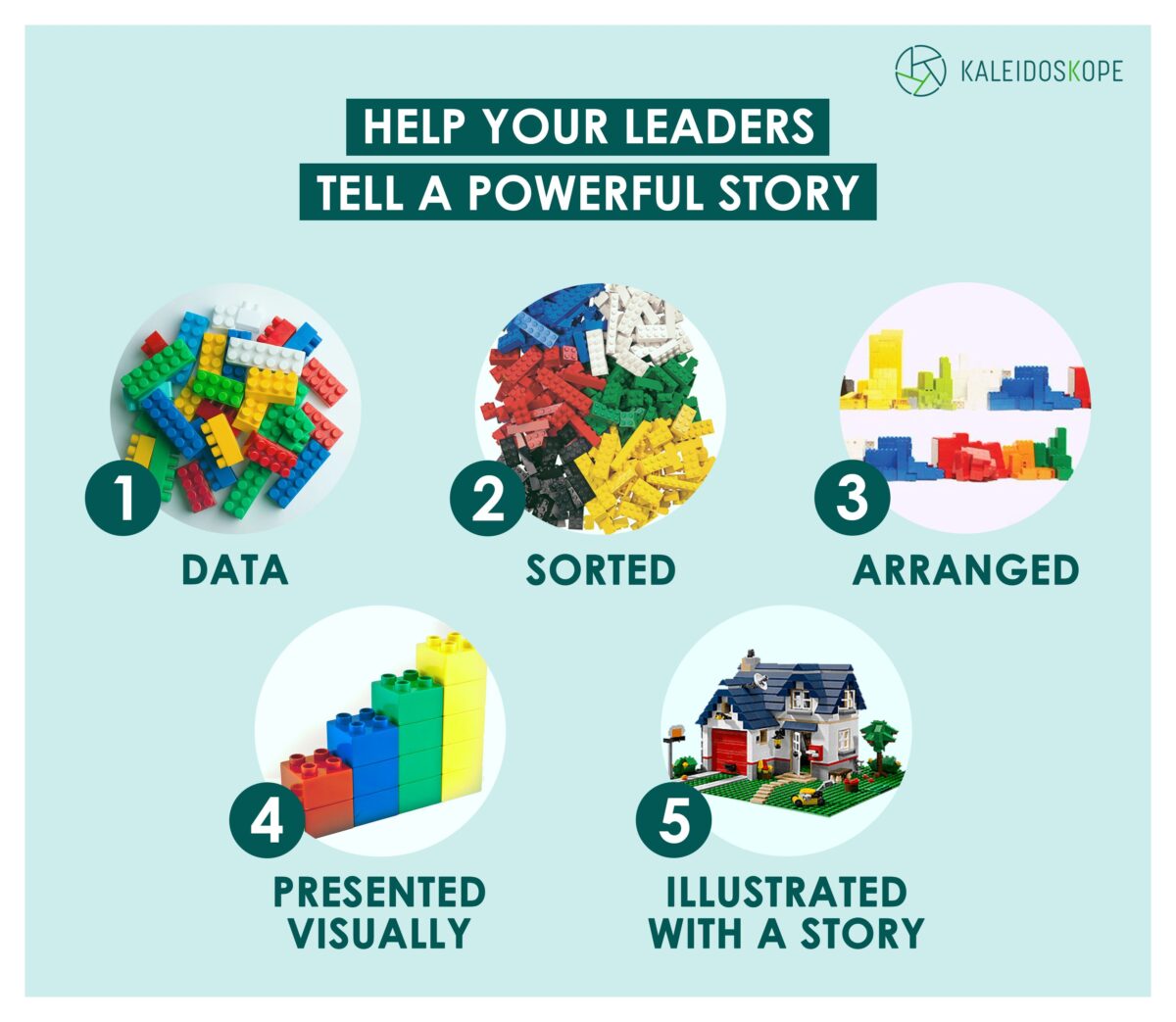
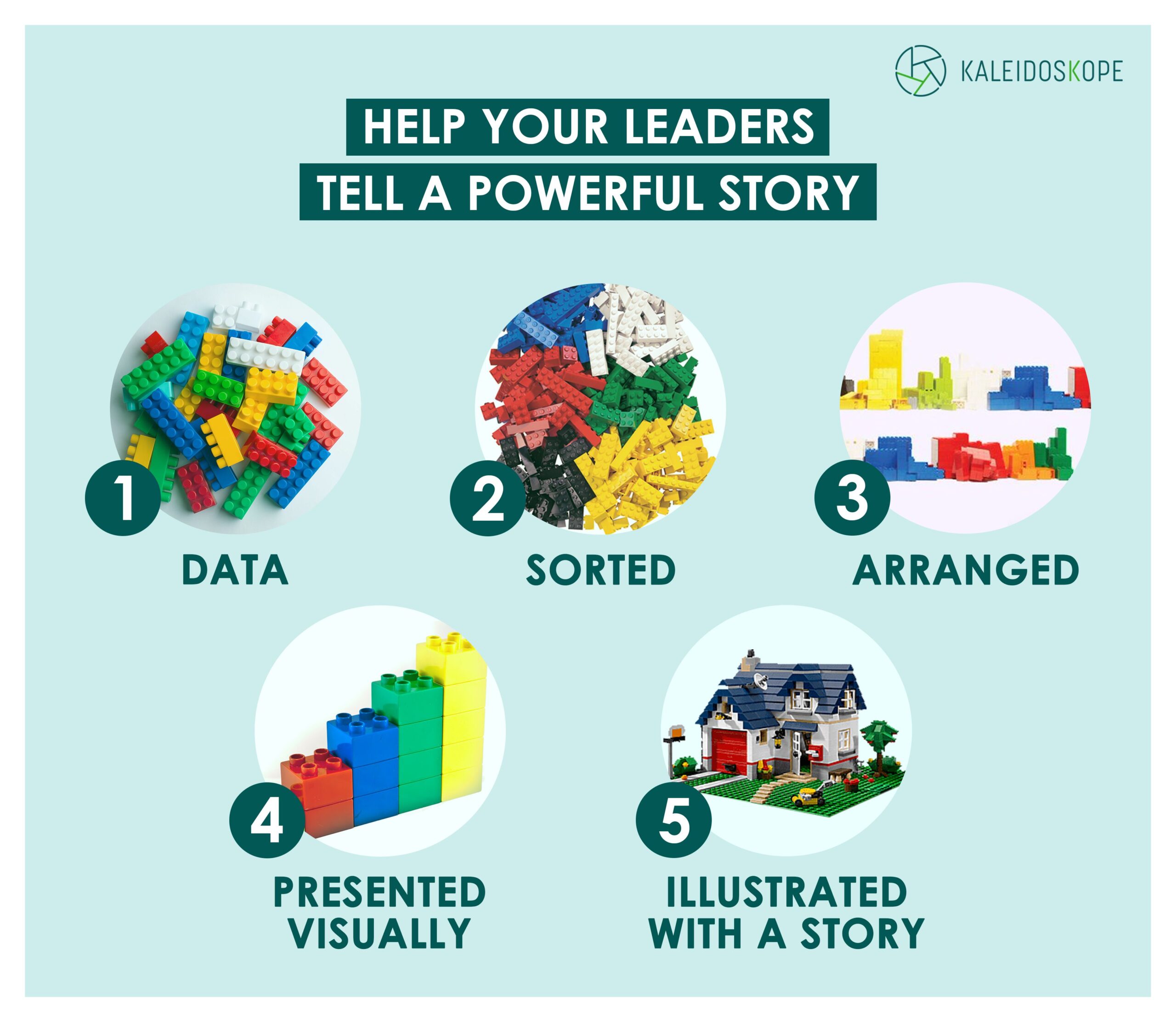
Help Your Leaders Tell a Powerful Story

Help Your Leaders Tell a Powerful Story

There’s no way around it.
 
Setting team goals is a pointless exercise until you have measured your baselines or benchmarks, considered what you want to, or need to achieve and then communicate and get the commitment of your team.
 
And to accomplish this, you will need DATA.
 
In our business landscape today of constant flux and rapid transformation, no organisation can survive without data.  But the avalanche of data can be daunting and pretty useless if it isn’t distilled for value, begging the question:  “What is this data good for?”

Data visualisation comes in here to help your leaders visually, accurately and impactfully arrange the value of metrics and numbers through charts, tables, graphs and most importantly, to provide context, identify and highlight key issues.  So that you get your message across clearly and effectively.

Our data visualisation workshop focuses on 4 key competencies:

  1. Data representation:  the most effective formats for accurately representing data
  2. Visual clarity:  identify and highlight information in your visuals
  3. Data interpretation:  draw accurate inferences and conclusions from data available
  4. Insight building:  present data that helps your audience arrive at the right insights 

And then that makes data a little less dry.

Fuse this approach with Business Storytellingand now you have a synergistic approach to tell a very powerful story.

Your data is now a story.

Human beings have been telling stories for a very long time.  We think in stories, we remember in stories and we ALWAYS remember a good story.  And here at Kaleidoskope, we’ve always believed that leaders should be able to tell good stories!

So by now, your data is a compelling narrative and you are influencing, inspiring and evangelising your team into action, driving everyone in the right direction to desired outcomes.

Of course this is no small feat and it does sound like a tall order.

But we can help.  And we can do this by working in close partnership with you to tailor, customise, craft learning and development solutions that best meet your needs.

Call us today at +65 65497 535 or fill out the form below if you want to know more. And let us tell you our stories

Related Blogs

The Mid-Year Reset: Mindful Reflection Over Resolutions

The Mid-Year Reset: Mindful Reflection Over Resolutions

We’ve all witnessed leadership failures in politics, business, and sports. A leader’s mistake and subsequent fallout reveal much about leadership, or the lack thereof. A recent incident involving the US Defence Secretary and other high-ranking officials is a stark warning, underscoring a critical gap within organisations that leadership training can bridge.

Start Your High-Performance Learning Journey

with Kaleidoskope NOW!

Or Fill Out the Form Below

What We Can Do For You
About Kaleidoskope
Resources
Contact

  +65 9100 5995

  +65 6809 5000

  +65 6809 5001

  ask@kaleidoskope.co


Google Review Badge - Kaleidoskope - Corporate Training & Learning Solutions (Singapore)