
Invert, Always Invert: A Mental Model for Stronger Teams
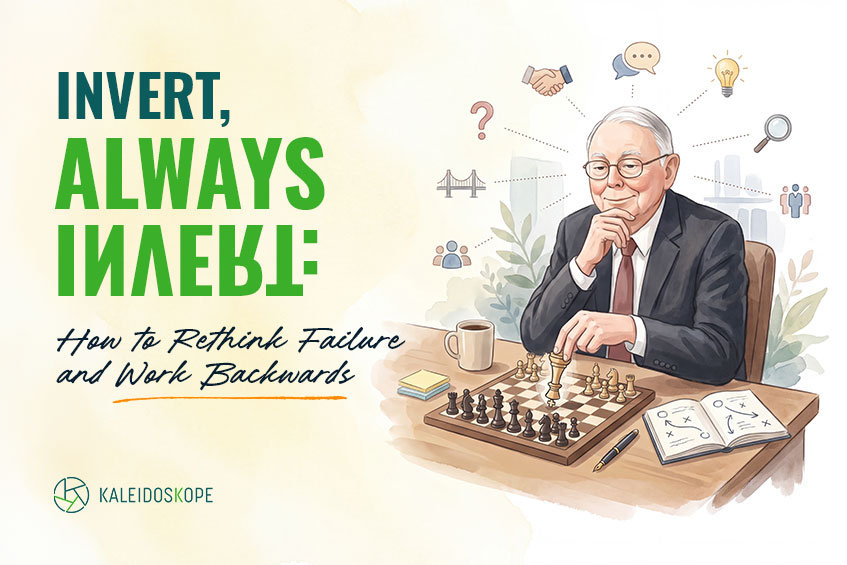
Charlie Munger’s favourite mental model, applied to your team
By Hwee Ching Ho
Director, Kaleidoskope Pte Ltd
“Invert, always invert.”
That line is attributed to Carl Gustav Jacobi, a 19th-century mathematician who taught in a way that many of his peers did not. In a manner almost similar to the approach of some Singaporean teachers (read: almost torturous) he encouraged his students to work backwards from the problem.
His logic was that the hardest problems often crack open when we stop pushing forward and ask what failure looks like instead.
Charlie Munger made the phrase famous more than a century later, applying inversion to investing, decision-making and life. Instead of asking only, “How do we succeed?”, Munger encouraged people to consider the opposite question: “What would guarantee failure?”
Then, avoid doing that.
It sounds almost too simple. Yet it can be surprisingly useful when applied to teams.
When leaders want a team to perform better, they often begin by asking what a successful team should do. Communicate more. Collaborate better. Take ownership. Focus on results.
All sensible answers.
But what happens when we invert the question?
Instead of asking what makes a team successful, ask: What slowly kills a team?
Patrick Lencioni’s model of the five dysfunctions of a team gives us a useful way to explore that question. Rather than presenting teamwork as a collection of ideal behaviours, the model identifies five conditions that undermine it:
- Absence of trust
- Fear of conflict
- Lack of commitment
- Avoidance of accountability
- Inattention to results
The dysfunctions build on one another. Problems near the base do not stay there. They move upwards, weakening the team’s ability to make decisions, hold one another accountable and work towards shared outcomes.
So, let’s invert the first two.
1. Absence of Trust
Within the Lencioni model, trust is not simply about believing that your colleagues are competent or dependable. It is the kind of trust that allows someone to say:
“I messed up.”
“I don’t know.”
“I need help.”
“I think I may have misunderstood.”
It is the confidence that admitting uncertainty or making a mistake will not be used against you later.
Trust rarely disappears through one dramatic incident. More often, it erodes in quiet, predictable ways. It happens when looking competent counts for more than being honest. When the person in charge never admits to getting anything wrong. When questions are interpreted as weakness.
None of this looks dramatic. It is happening in more teams than most organisations let on—usually without anyone naming it.
A useful inversion exercise is to ask: If we wanted to destroy trust in this team, what would we do?
Would we punish mistakes? Reward certainty over curiosity? Allow seniority to determine who can challenge an idea? Avoid difficult conversations until frustration spills out elsewhere?
2. Fear of Conflict
Teams that avoid conflict are not necessarily harmonious. They are often quiet in the meeting room and loud in the pantry afterwards. On the surface, everyone appears polite. Underneath, very little has been resolved.
This is what makes conflict management so important. The goal is not to eliminate disagreement. It is to create the conditions in which disagreement can happen honestly, respectfully and productively.
When people ask how to handle conflict at work, they often assume that conflict itself is the problem. But conflict is not always evidence that a team is broken.
Sometimes, it is evidence that people care about what happens next.
The deeper problem begins when disagreement is interpreted as a personal attack. It grows when leaders are uncomfortable with tension and shut it down every time it appears. It becomes embedded when employees learn that being agreeable is safer than being candid.
And when teams keep sweeping conflict under the carpet, someone will eventually trip over it.
That is the problem.
Most teams are not short on ideas. They are short on rooms where it feels safe to disagree out loud.
“Nice” Is Not the Same as Healthy
There is nothing wrong with being considerate. Respect matters. Kindness matters.
But “nice” is not always healthy.
A team can be warm, friendly and deeply conflict-averse. People may enjoy working together but still avoid questioning weak ideas, challenging unrealistic deadlines or raising concerns about a colleague’s behaviour.
Over time, artificial harmony creates its own form of tension.
Issues remain unresolved. Resentment builds. Decisions are made without genuine commitment. The conversations that should happen as a team take place privately between individuals instead.
Productive conflict looks different.
It focuses on the issue rather than the person. It allows people to test assumptions, examine competing priorities and voice concerns before a decision is made. It does not require everyone to agree. It requires everyone to participate honestly.
This is also where trust and conflict become inseparable.
Without trust, disagreement feels dangerous. People protect themselves, defend their image and calculate the interpersonal cost of speaking up.
With trust, team members can challenge an idea without rejecting the person who proposed it. They can change their minds without losing face. They can leave a difficult discussion knowing that the relationship remains intact.
Good conflict resolution practices therefore begin long before a disagreement escalates. They are built through everyday leadership behaviours: admitting mistakes, inviting dissent, listening without becoming defensive and making it clear that respectful challenge is part of the work.
What Leaders Do With Tension Matters
Leaders shape a team’s relationship with conflict through what they model and what they tolerate.
When a leader rushes to smooth over every disagreement, the team learns that tension is dangerous. When a leader responds defensively, people learn to stay silent. When difficult behaviour repeatedly goes unaddressed, employees learn that candour carries more risk than avoidance.
By contrast, leaders can make disagreement safer by asking:
“What are we not saying?”
“Who sees this differently?”
“What assumptions are we making?”
“What might go wrong with this decision?”
These are inversion questions. They give people permission to examine what could fail before failure happens.
The Foundation of Team Performance
Trust and conflict form the foundation of Lencioni’s model. Get those two wrong and the next three—commitment, accountability and results—do not stand much of a chance.
Without genuine debate, people may appear to agree without truly committing. Without commitment, accountability becomes difficult: why hold someone to a decision they never meaningfully supported? And when accountability weakens, individual agendas begin to take priority over collective results.
No amount of strategy or talent can fully compensate for a team that is cracked at the base.
So, perhaps the place to begin is not by asking how to make your team more successful.
Invert the question.
What is your team doing that makes trust less likely?
Which conversations are being postponed?
Where has politeness replaced honesty?
The answers may be uncomfortable. They may also be the beginning of something far healthier.
Invert, always invert.
So, how are the other three dysfunctions manifested? More importantly, where is your team stuck?
Related Blogs

The First-Time Manager Trap: Why Experts Struggle to Lead
Why do strong technical experts often struggle when they become managers? The challenge is not ability, but the shift from delivering results personally to leading through others. Explore the mindset, skills, and support first-time managers need to make the transition successfully.
Avoiding the Tacitus Trap (How leaders can communicate when trust is fragile)
A flight delay and a detour into a bookshop led to an unexpected leadership lesson. The Tacitus Trap explains why, when trust is low, even well-intentioned decisions are met with suspicion, and why facts alone are rarely enough to persuade.

Leadership Transitions: Why the First 90 Days Make or Break New Leaders
New leaders rarely fail on competence. They fail in the first 90 days. Learn the four types of leadership transition, and the 90-day plan that turns a high-risk appointment into a reliable win.