
The Foundation of Team Engagement?
It Starts with Trust
Why trust drives stronger team engagement and performance
By Hwee Ching Ho
Director, Kaleidoskope Pte Ltd
Only 20% of employees globally are engaged at work. Manager engagement is just 22%.¹
Those numbers matter because employee engagement has a measurable impact on how organisations perform. Gallup’s research finds that, compared with teams in the bottom quartile of engagement, highly engaged teams see 78% less absenteeism, 23% higher profitability and as much as 51% lower turnover in lower-turnover organisations.²
Yet employee disengagement rarely begins as an engagement problem.
Often, it begins much closer to home. It starts with the team.
It happens when people stop speaking openly because they are frightened of the consequences. Difficult conversations get swept under the carpet, until someone keeps tripping over them. Team members begin holding back questions, concerns or disagreements because staying quiet feels safer.
Over time, commitment to the team vision or objective weakens. Accountability slips. Individual priorities and personal ambitions begin to outweigh the collective results the team is trying to achieve.
By the time this shows up in an engagement survey, the problem may have been building for quite some time.
Employee Engagement Is Built in the Team
We often think about employee engagement at an organisational level. We look at survey scores, culture initiatives, wellbeing programmes, benefits, communication or recognition.
All of these have a role to play. But an employee’s everyday experience of work is also shaped by the team around them.
Can I disagree with my colleagues without damaging the relationship?
Can I admit that I made a mistake?
Can I ask for help without looking incapable?
Do we understand what we have committed to as a team?
These are not abstract questions about culture. They are lived experiences that shape how people participate at work.
This is why team trust matters.
Trust creates the conditions for people to contribute honestly rather than cautiously. It allows team members to put an unfinished idea on the table, acknowledge what they do not know, challenge an assumption or raise a concern before it becomes a larger problem.
Without that foundation, even talented teams can become guarded.
Trust Does Not Mean Avoiding Disagreement
One common misunderstanding is that a trusting team should be harmonious.
In practice, trust should make honest disagreement easier.
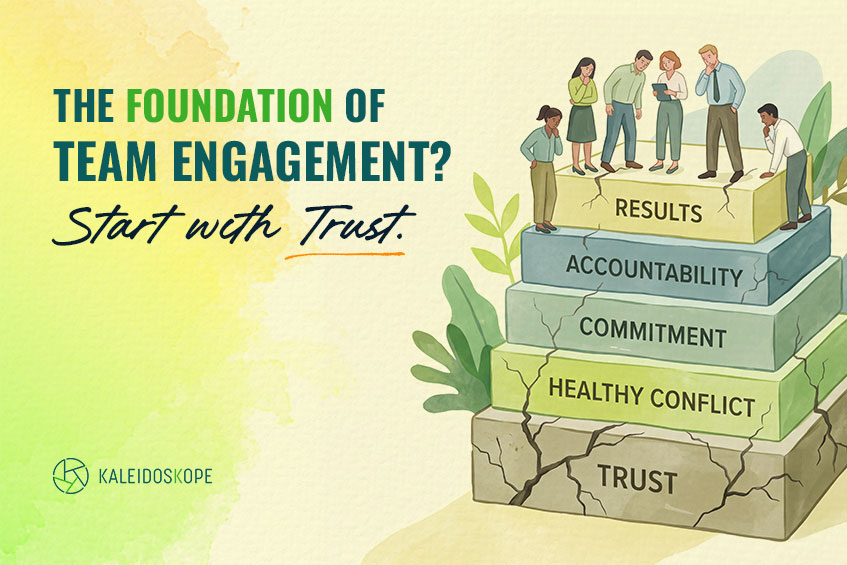
Patrick Lencioni’s The Five Dysfunctions of a Team captures this through a model that moves from trust through conflict, commitment and accountability to results:
Trust → Healthy Conflict → Commitment → Accountability → Results
In Lencioni’s model, an absence of trust makes people reluctant to be vulnerable with one another. That can lead teams to avoid productive conflict. Without genuine discussion and debate, commitment becomes more difficult. When commitment is unclear, holding one another accountable becomes uncomfortable. Eventually, attention shifts away from collective results.³
Seen this way, team performance is not simply the product of having capable people in the room. It also depends on what those people are able and willing to do together.
Healthy conflict, for example, does not mean encouraging arguments for the sake of them. It means creating enough trust for people to question ideas, explore disagreements and surface concerns without turning those differences into personal battles.
This is where team collaboration becomes more than simply cooperating politely.
From Healthy Conflict to Commitment
When teams avoid difficult conversations, apparent agreement can be misleading. A meeting may end with everyone nodding, while different versions of the decision leave the room.
Healthy conflict, on the other hand, gives teams the opportunity to test an idea before committing to it. People can ask questions, raise objections and understand why a decision has been made, even if it was not the decision they personally preferred.
For leaders working on team development, this can be an important shift. The aim is not to eliminate friction. It is to help the team use friction constructively.
Accountability Is a Team Practice
The next step is often one of the hardest.
Once a team has made a clear commitment, are team members willing to hold one another to it?
Without sufficient trust, accountability easily becomes something left to the manager. Colleagues may see behaviour that undermines the team but remain silent because raising it feels too uncomfortable.
In high performing teams, accountability becomes more shared. Team members understand the standards they have agreed to and are prepared to have the conversations required to protect them.
It means making expectations clear enough, and relationships strong enough, that feedback can be given before frustration turns into resentment or performance suffers.
Keeping Collective Results in View
The final question is simple: what are we here to achieve together?
Teams can contain highly capable people who are all succeeding individually while the team itself struggles.
Departmental interests take precedence. Personal recognition matters more than the shared outcome. People optimise their own piece of the work without considering its effect on everyone else.
Strong team performance requires a shared definition of success.
People are more likely to invest themselves in work when they understand what they are contributing to, feel able to speak honestly and know that the people around them are working towards the same outcome.
Building High Performing Teams from the Foundation Up
At Kaleidoskope, we see these dynamics playing out across industries and different kinds of teams.
That is why our High-Performing Teams programme begins with how teams work together.
Drawing on Lencioni’s Five Dysfunctions framework, the learning journey helps teams explore the foundations beneath performance: building trust, engaging in healthy conflict, strengthening commitment, creating mutual accountability and maintaining focus on collective results.
The purpose is not to wait until a team is visibly struggling.
Team development can be particularly valuable when leadership teams are taking on new responsibilities, cross-functional groups need to collaborate more effectively, or teams are navigating periods of organisational change.
These moments often place existing ways of working under pressure. Misunderstandings become easier. Priorities compete. Conversations become harder just when they are most necessary.
Investing in the foundations gives teams a shared language for recognising what is happening and working through it together.
Because employee engagement is not created by an engagement initiative alone.
It is built through everyday experiences of work. Through whether people trust one another enough to speak. Whether they can disagree productively. Whether commitments mean something. Whether accountability is shared. And whether everyone remains focused on what they are trying to achieve together.
If you are strengthening a leadership team, building cross-functional collaboration, or supporting teams through change in 2026 or 2027, Kaleidoskope can tailor the High-Performing Teams learning journey to your organisation and the realities your teams are facing. Enquire about our high-performing teams programme.
Sources
¹ Gallup, State of the Global Workplace: 2026 Report. Global employee engagement: 20%; manager engagement: 22%.
² Gallup, Q12® Meta-Analysis: The Relationship Between Engagement at Work and Organisational Outcomes. Top-quartile versus bottom-quartile engagement differences include 78% lower absenteeism, 23% higher profitability and 51% lower turnover among lower-turnover organisations.
³ Patrick Lencioni / The Table Group, The Five Dysfunctions of a Team. The model progresses from absence of trust through fear of conflict, lack of commitment, avoidance of accountability and inattention to results.
Related Blogs
Invert, Always Invert: How to Rethink Failure and Work Backwards
What if the best way to build a stronger team is to ask what would destroy it? This article applies Charlie Munger’s inversion mental model to trust, conflict and the foundations of effective teamwork.
The First-Time Manager Trap: Why Experts Struggle to Lead
Why do strong technical experts often struggle when they become managers? The challenge is not ability, but the shift from delivering results personally to leading through others. Explore the mindset, skills, and support first-time managers need to make the transition successfully.
Avoiding the Tacitus Trap (How leaders can communicate when trust is fragile)
A flight delay and a detour into a bookshop led to an unexpected leadership lesson. The Tacitus Trap explains why, when trust is low, even well-intentioned decisions are met with suspicion, and why facts alone are rarely enough to persuade.